Brothers In Arms: Inside India & Israel’s Billion-Dollar Nexus of Military Deals, Corporate Power & Ethnonationalism
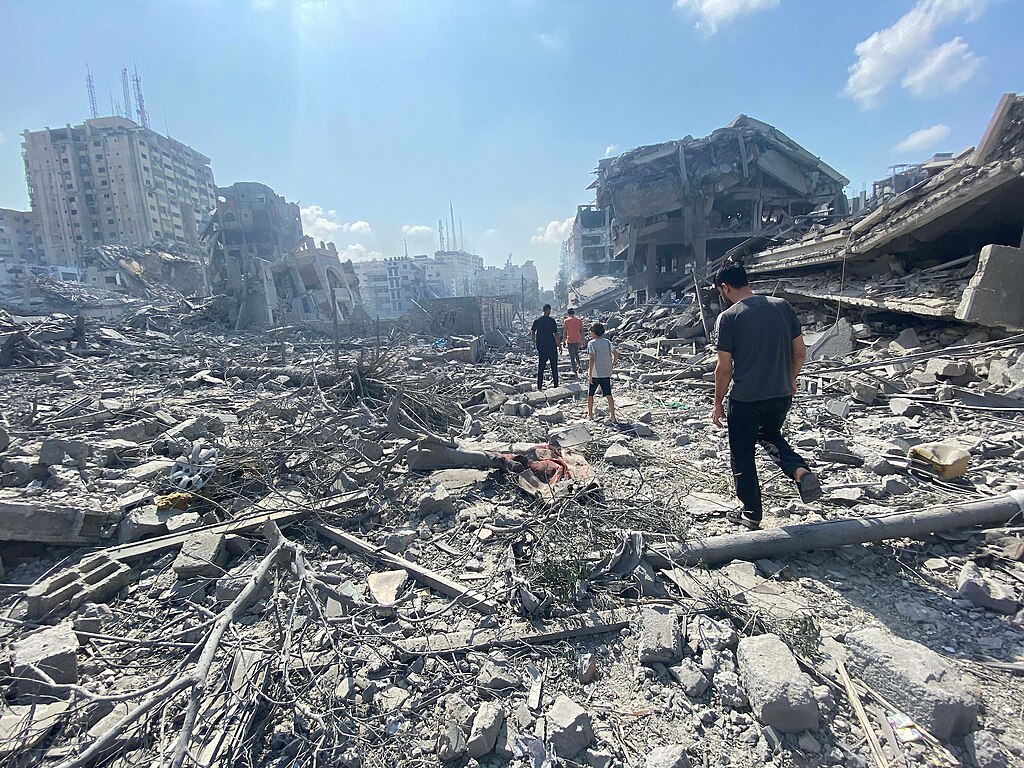
As Israel’s brutal occupation of Gaza continues under Donald Trump’s so-called ceasefire agreement, A Pal takes a look at how India became one of Israel’s biggest international cheerleaders even as it committed genocide against the Palestinian people, and why this signals a new era of militarised capitalism and religious authoritarianism between the two states.
Cover image: Benjamin Netanyahu and Narendra Modi embrace at an India-Israel Business Summit in New Delhi, 2018. MEAphotogallery, licensed under CC BY-NC 2.0
On 8 September, Bezalel Smotrich arrived in New Delhi amidst much pomp and celebration to sign what the Indian government hailed as a “historic milestone”, the Bilateral Investment Agreement (BIA).
The far-right Israeli finance minister, sanctioned by multiple Western states and facing pending arrest warrant applications at the International Criminal Court (ICC), posed for photographs as the two governments pledged to deepen cooperation in “cybersecurity, defence, innovation and high-technology.”
Just days earlier in the United Kingdom, Israeli President Isaac Herzog’s visit had drawn mass protests outside 10 Downing Street, with demonstrators accusing Keir Starmer’s government of “enabling genocide” for hosting him.
But even the UK government, which continues to provide military intelligence to the Israeli Occupation Forces (IOF), decided to suspend its free trade negotiations with Israel in May.
So when India, once a vocal supporter of Palestine and one of the first countries to recognise the Palestinian state in 1988, made a public show of binding itself closer to Israel, almost in defiance of a growing global consensus against the settler-colonial state, the shift might have seemed abrupt. It was, however, anything but.
In the past decade, India has dismantled its post-Independence posture of anti-imperial solidarity and recast itself as one of Israel’s most committed allies, anchored in arms, capital, and ideology.
As the country emerged from the wreckage of British colonial rule in 1947, its nascent leadership sought to define itself through non-alignment, anti-colonialism and anti-imperialism generally. In that framework, support for Palestinian liberation was almost instinctive. Just months after independence, Jawaharlal Nehru’s government voted against the creation of the Israeli state, with the prime minister denouncing the United Nations’ Partition Plan for Palestine. He accused Zionist lobbyists of attempting to bribe India with millions of dollars and threatening his sister, Vijaya Lakshmi Pandit — then India’s ambassador to the UN — with death threats.
Although historians have questioned the integrity of Nehru’s pro-Palestinian stance, this posture of solidarity held for decades. India became the first non-Arab country to recognise the Palestine Liberation Organization as the legitimate representative of the Palestinian people in 1974, and did not establish diplomatic relations with Israel until 1992.
So when India became the only South Asian country to abstain in the UN General Assembly’s vote for a humanitarian truce between Israel and Palestine on 27 October 2023, it marked a historic shift in the country’s foreign policy. Many read it as emblematic of the country’s submission to neoliberal politics, which has paved the way for the rise of a quasi-authoritarian and sectarian regime led by Bharatiya Janata Party’s (BJP) Narendra Modi, serving as prime minister since 2014.
Under Modi, divisions between the country’s Hindu majority and Muslim minority have deepened, often propagated by its ‘lapdog’ media and at other times, via state-sponsored Islamophobia. Several BJP leaders have made their disdain for Muslims, who account for 15 per cent of India’s population, well-known in the last decade. Modi has even been labelled as the “architect of riots” in light of accusations that he deliberately allowed the 2002 Muslim pogrom to take place in Gujarat while serving as chief minister.
This assault on Muslim life has been two-pronged. While the state has utilised systematic laws and arbitrary policies of discrimination, restriction of upward social mobility, interfaith matrimony, and suppression of religious expression, worryingly large sections of the public have also played a part, with harassment, bigotry, mob lynchings and sexual violence.
At the heart of the country’s assault on minorities is ‘Hindutva’, an ideology that seeks to establish Hinduism as the dominant religion and way of life in not just the country, but the entire south-Asian subcontinent, and is a core tenet of the BJP’s policies.
One of its major objectives is the vision of the ‘Akhand Bharat’ — establishing a unified Greater India comprising Pakistan, Afghanistan, Tibet, and various neighbouring states purged of Muslims, Christians and other religious minorities.
If this already sounds eerily similar to Zionism — Israeli state ideology, whose objective, in Israeli scholar Ilan Pappé’s words, is to “take over as much of Palestine as possible with as few Palestinians as possible” — you wouldn’t be wrong. Academic, activist, and Transnational Institute Fellow, Achin Vanaik, claims there exists an “ideological kinship” between Hindutva and Zionism, while political scientist Christophe Jaffrelot and researcher and journalist Kalrav Joshi note, “Both are characterised by ethno-nationalist ideologies that prioritise factors like race, of course, but also territory and nativism.”
While Zionism, founded by Theodor Herzl in 1897, became a driving force in the early 20th century and culminated in the creation of the state of Israel in British-occupied Palestine, Hindutva was a term coined in 1923 by V. D. Savarkar. Economist Ashoka Mody points out that the ideology found an early, almost ignorant sympathiser in former Indian prime minister Rajiv Gandhi in the 1980s, who was trying to appease the Hindu majority, before it was made mainstream at the turn of the century by the tenth prime minister of India, Atal Bihari Vajpayee.
Vajpayee was a lifelong member of the Hindu-nationalist Rashtriya Swayamsevak Sangh (RSS), the world’s largest far-right and paramilitary organisation, as well as the ideological crucible that birthed the BJP. Under Modi — another member of the RSS — the organisation’s extremist aspirations have become entwined with national politics.
South African journalist Azad Essa, in his seminal book ‘Hostile Homelands: The New Alliance Between India And Israel’, describes this as a “civilisational affinity” between followers of the two ideologies, writing: “As Hindutva began to take root as a mainstream ideology, its proponents latched on to the idea of Israel as an expression of that aspiration, again, in opposition to the ‘Muslim’ and ‘Arab’ cause of Palestine.”
As religious fundamentalism followed in the footsteps of late capitalism, Indian bureaucrats grew more and more impudent in courting not only Israeli blueprints and policies, but also material goods like arms, technology, and infrastructural prudence. In 2000, BJP’s L. K. Advani became the first Indian Home Minister to visit Israel. That was soon followed by a visit from Foreign Minister Jaswant Singh, the first in his portfolio to do so.
And with Modi’s ascent to power, whatever anxieties or apprehensions existed in reifying ties between the two states were washed away. In his typical bare-chested and swashbuckling manner, Modi, just months after taking oath as the Indian PM, shook hands with Benjamin Netanyahu at the UN General Assembly, in the aftermath of Operation Protective Edge, an Israeli offensive in Gaza which took the lives of more than 2,000 Palestinians, 65 to 70 per cent of them civilians.
What started out as the Indian government’s refusal to condemn Israel’s disproportionate killings in 2014, both at the Parliament and at the UN Human Rights Council, soon led to unprecedented deals with Israel in agriculture, water conservation, and technology worth billions. Meetings and visits between the two leaderships became a regular affair, parlayed with the infamous bear hug as well. Within a few decades, India had morphed from being a critic of the Zionist state to adopting a “de-hyphenated approach” and establishing a “strategic partnership”.
And then there’s the issue of the deep ties between the two countries’ military industrial complex. Israel has served as an arms supplier to India since Nehruvian times, assisting the Indian army in its wars — first with China in 1962, and then with Pakistan in 1999. One of the primary driving forces of the tension between India and Pakistan has been Kashmir, one of the only Muslim-majority regions in India, and also a region that many argue India has illegally occupied and turned into the world’s most densely militarised zone, with the Indian army abetting and committing a range of human rights abuses, including forced disappearances, brutal torture of detainees, and using rape as a strategy to humiliate its people.
As the US waged its War on Terror following the 9/11 attacks in 2001, India saw it as an opportunity to correlate the Muslim insurgents’ freedom movement with terrorism, justifying its occupation of the northern valleys.
In the book ‘The Palestine Laboratory: How Israel Exports the Technology of Occupation Around the World’, journalist Antony Loewenstein argues that Israel uses the occupied Palestinian land as a testing ground for weapons, border security enforcement, and ‘homeland security’ — an all-encompassing approach to domestic surveillance and territorial control — before selling them around the world, turning its history of violence into a “brand” to attract potential buyers. This brand was deemed quite lucrative by India, which, in the aftermath of several attacks, including the 2001 bombing on the Parliament and the 2008 Mumbai attacks, known as “India’s 9/11” or simply “26/11”, has become Israel’s largest defence customer.
According to Essa, the Indo-Israel relationship “received an anti-Muslim booster shot under the guise of fighting terror”, by deploying Israeli-made rifles, armed drones, and mass surveillance tools to attack Kashmiris, as well as to patrol the Line Of Control (LoC) between the Indian-administered territory of Jammu and Kashmir and “Azad”, or Independent, Kashmir, commonly referred in Indian media as ‘Pakistan-occupied Kashmir’ (ironically, in India, you cannot access a map showing the two territories separated by the LoC, and depiction of such a map is a crime punishable by up to seven years in jail and a fine of £8.4 million).
Between 2001 and 2021, India imported £3.1 billion worth of Israeli arms, which during Modi’s first prime ministerial tenure, rose by 175 per cent. But the gravity of deepening military ties is not solely incumbent on India’s dependence on Israeli imports. The two leading billionaires of the Indian economy, Mukesh Ambani, chairman of Reliance Industries, and Gautam Adani, chairman of the Adani Group, have a long list of vested interests. They also happen to be two of the richest men in the world and Modi’s closest aides, involved in notable high-profile scams and corruption scandals.
Reliance has invested heavily in Israel, from oil and telecommunications to entertainment technology and apparel industries, besides the obvious ventures in the arms sector. In 2016, Reliance Defence announced a partnership with Rafael Advanced Defence Systems, an Israeli state-owned arms company specialising in missiles, air defence systems and aerostats, to oversee projects worth £7.4 billion in the next ten years.
In May last year, Spanish authorities denied entry to a cargo ship in Cartagena, Colombia. It was later revealed that the vessel, carrying 27 tonnes of explosives for the IOF, had originated in India and was destined for Haifa, a city whose docks are owned by Adani Ports.
Unsurprisingly, that’s not the only war-machine-flavoured pie Adani has his fingers in. In 2018, his group joined hands with Elbit Systems, Israel’s biggest arms manufacturer, to produce the lethal Hermes 900 drone for use by both the Indian and Israeli military. To this day, the joint venture’s manufacturing facility in Hyderabad remains the sole such site of its kind outside Israel.
So when Netanyahu came calling in February, Adani duly obliged — promptly manufacturing and shipping 20 such drones to be used in Gaza. In fact, accounts of Indian-made ammunition being deployed have emerged since June last year, when footage of a missile bearing the label ‘Made in India’ — the Modi government’s national programme to bolster domestic production — was shared on social media in the aftermath of an Israeli bombing at the UN refugee shelter in Nuseirat, five kilometres north-east of Deir al-Balah.
While the bureaucratic and capitalist limbs of the Indian body have fulfilled their role in enabling the genocide and the subsequent famine in Palestine, the media and the vocal far-right have taken it upon themselves to sanitise Netanyahu and Israel’s actions, not only invoking Islamophobic messaging, but also taking a page out of the Hasbara playbook and framing it as an existential battle for a sacred, holy nation surrounded by enemies, a message that seemingly resonates with the Indian public.
Journalist and writer Kalpana Sharma accused the Indian media of “toeing the government line” back in December 2023, describing the minuscule coverage of the unfolding tragedy in Gaza as “selective and one-sided, playing up one side and playing down another.”
Meanwhile, an even more disingenuous disinformation campaign has been heralded by the nation’s Hindu right-wing and the BJP IT cell on Twitter/X, sharing false images and videos and denouncing them as “Hamas atrocities”. One of the hashtags that went viral in October 2023 was ‘#IslamIsTheProblem’, with one retired Indian soldier also writing: “Israel must finish off Palestine from the face of the planet.”
Professor of Middle East studies, Dr Marc Owen Jones, said: “The plight of Palestinians has drawn Islamophobes like moths to a light and this can be witnessed on social media.” Pratik Sinha, co-founder and editor of the Indian non-profit fact-checking website AltNews, also wrote: “With India now exporting its disinformation actors in the Indian mainstream media and on social media in support of Israel, hopefully the world will now realise how the Indian right-wing has made India the disinformation capital of the world”.
Rallies and marches have been organised by Hindu right-wing groups as well, complete with Israeli flags, placards saying “I Stand With Israel”, and posters of Netanyahu, sometimes even garlanded with marigolds. The common sentiment among such crowds was that Israel is fighting a ‘proxy war’ on behalf of Hindus.
At the same time, pro-Palestinian protesters have faced incessant crackdown from authorities, with several people arrested and detained.
On numerous occasions, expressions of solidarity, such as displaying banners calling for boycotting Israel, carrying the Palestinian flag, and simply sharing pro-Palestinian messages on WhatsApp, have led to formal arrests and witch-hunts from right-wing mobs, often indiscriminately targeting Muslims.
At a recent protest in New Delhi, a bunch of people were dragged and thrown into police vans, some even sustaining serious injuries.
Despite the brutal repression, such demonstrations have continued to take place, often led by student and activist groups but at times, also organised by opposition parties. In July, the Bombay High Court dismissed a petition from the Communist Party of India (Marxist) [CPI(M)] challenging the police’s refusal to grant permission for a protest, saying: “Our country has enough issues. We don’t want anything like this… you are all short-sighted. You are looking at issues in Gaza and Palestine. Look at your own country. Be patriots. This is not patriotism.”
The party’s leaders were also one of the few from the opposition to condemn the government’s “complicity in the ongoing horrific genocide in Gaza” in light of signing the BIA, along with Asaduddin Owaisi of the All India Majlis-e-Ittehadul Muslimeen who called it “despicable.” Hundreds of people also came together to form a human chain in New Delhi to oppose the trade deal and Smotrich’s presence in India. However, these remarks and protests were drowned out by the celebratory tone of the government’s statements.
It goes to show the extent to which solidarity with Palestine has been undermined by the state. Ties between the two countries, in the capitalist sacrosanct guise of trade, already stood close to $4 billion last year. The signing of this latest bilateral agreement, as Essa writes, “ties India and Israel’s economies for the long run” and shows that “New Delhi didn’t merely signal support for Israel, but promised to tether its economic and political destiny to it.”
While some would argue that Indian diplomats still recite boilerplate lines about a “two-state solution”, it’s evident that these handful of symbolic acts are nothing more than multilateral crumbs to preserve foreign relationships and legacy rhetoric, paired with a steady material-ideological alignment with Israel. Vanaik notes, under Modi, Hindutva’s affinity with Zionism has produced “unequivocal admiration and indeed emulation of how Israel dealt with the Palestinian ‘enemy’ in the occupied territories.”
Looking closely, one can see what this emulation looks like at home. As Essa writes in his book, in 2019, India’s consul general in New York told a Kashmiri Hindu audience that the state would build settlements modelled after Israeli expansion in the West Bank in preparation for the settlement return of the Hindu population into Kashmir.
“We already have a model in the world. I don’t know why we don’t follow it. It has happened in the Middle East. If the Israeli people can do it, we can also do it,” he said.
Essa argues that the tacit objective is to “destroy the very idea of what it means to be a native”; an erasure-and-replacement logic that turns Kashmir into the proving ground of an ethnocracy.
He goes further, arguing that “all indicators suggest that a project of ethnic cleansing is well underway in India,” where minorities, activists, and every dissenting voice face suppression and disenfranchisement. Vanaik, meanwhile, insists that solidarity must go beyond Palestine itself: “to succeed in advancing the Palestinian cause in India, it is necessary to do more than simply focus on solidarity. This is also the way to create a wider arena of human and institutional sympathy and support.”
What must be confronted is not only the rhetoric of Hindutva and Zionism, but the material architecture that allows them to endure: the arms trade, the surveillance industry, and the networks of corporate and state power that render repression profitable. Seen in this light, the new Bilateral Investment Agreement is not merely an economic accord, but the institutional welding of two states whose power depends on militarism, capital and ethnonationalism.