“F*CK KEIR STARMER” – A NIGHT ON THE TERRACES WITH KNEECAP
Kneecap faced the full force of the British establishment over their uncompromising solidarity with Palestine – and won. Joe Healy joined a riotous, euphoric crowd for the group’s sell-out gig in Cardiff.
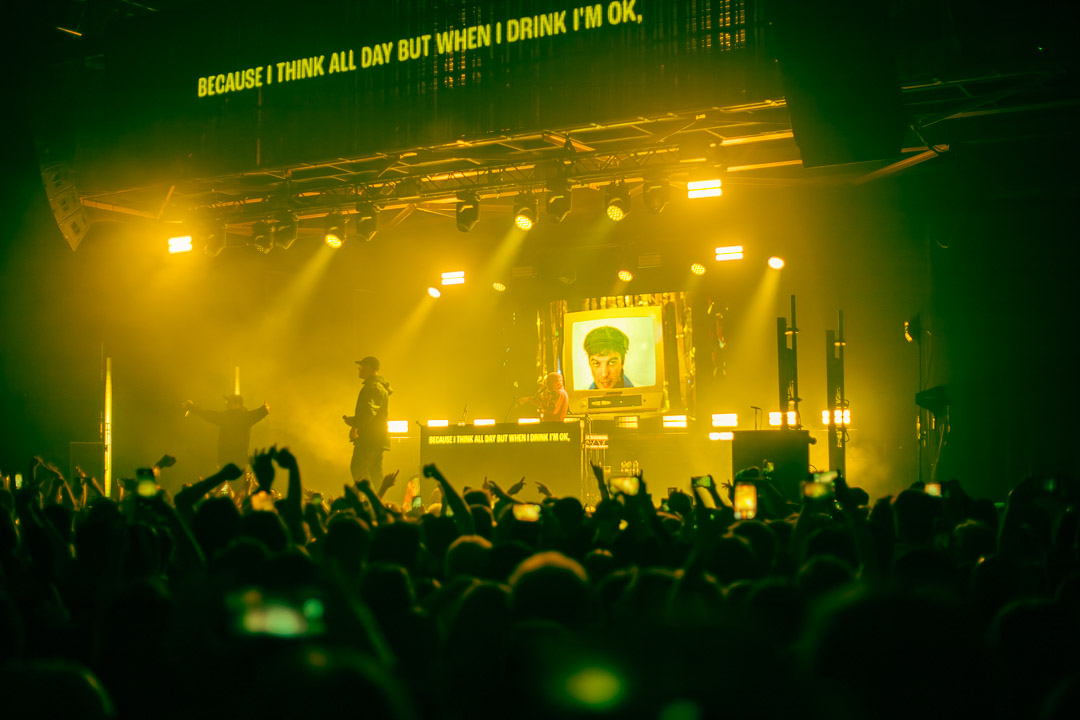
Cover image: Kneecap, DEPOT, Cardiff 17th November, by Rebecca Young @bckyng
Monday, 17th November 2025. Cardiff’s Depot hosts Irish hip hop trio Kneecap, who must be this year’s most infamous musicians, albeit in a crowded field. The spectacle of Kneecap’s own crowd this evening is a canvas of shirts on scarves on flags. The die-hard fans sport the Kneecap merch, many more wear slogans, colours and keffiyehs in solidarity with Palestine, and, as is custom when an Irish act plays in Britain, there’s a full pallet of football and GAA jerseys, with the additional flourish this evening of a good splash of Wales red.
A favourite item here is the bright pink and blue of a Bohemians third strip, with Irish band Fontaines DC as the front sponsor. This might seem odd, until you consider that Kneecap’s hit A Better Way To Live is a collaboration with Fontaines’ lead singer Grian Chatten, they’ve played many gigs together (including a sold out summer gig in London), and the shirt itself has been worn by Kneecap’s members on stage. It carries a small but obvious label stating: “Saoirse don Phalaistín” (Freedom for Palestine).
I didn’t wear mine tonight, but in this company, I feel at the centre of a very specific Venn diagram: the Irish diaspora, Palestinian justice, minority language representation (I’ve never heard this much Welsh being spoken at a non-Welsh-language event), and, of course, the amateur music aficionados who’ve come to see the new biggest thing.
At 9pm, the rainbow turns to black, and an on-screen message appears at the front of the room: “Israel is committing genocide against the Palestinian people”. Boos from the crowd, and the first of countless chants of “Free Palestine”. This silent on-screen message continues, detailing the UK Government’s complicity in Israel’s war on Gaza, and the crowd respond with “fuck Keir Starmer”. Kneecap themselves then come out to bedlam, and smash through a few songs without saying much, except the occasional “diolch”. They encourage the mosh pit which has formed in front of them, then turn immediately back to politics.
Kneecap are far from the only musicians backing the Palestinian cause, nor the only ones who have been made to suffer for it this year, but recent events have seen them defined by their convictions in a way that even they couldn’t have anticipated. They’re revelling in it.
“We beat the UK Government in court twice … two nil!”. Again, the atmosphere is somewhere between concert, protest and football match.
We’re reminded that Tory leader Kemi Badenoch, then UK Business secretary, tried to remove arts funding from Kneecap in 2024, resulting in a court case which found the UK Government guilty of discrimination against the group, and granting them a payout which they donated to both Catholic and Protestant youth organisations in the North of Ireland.
Then, this year, Kneecap’s Liam Óg Ó hAnnaidh, affectionately known as Mo Chara (My Friend), was dragged through the courts on terrorism charges for allegedly waving a Hezbollah flag on stage in 2024. This second case was dropped just a few weeks ago, but had been brought initially in the middle of Kneecap’s US tour. Clearly, someone had been sitting on it until Kneecap’s success over the pond made it politically convenient to try to attack them.
Ironically, the case was thrown out on a technicality, precisely because it had been brought long after the fact, so was deemed null, but that didn’t stop both the (now Labour) UK Government and the BBC voicing that Kneecap’s Glastonbury performance was inappropriate, and many of their gigs worldwide from being cancelled. Kneecap are clear about why they’ve been subjected to this most recent round of lawfare: “They’re trying to stop us talking about Palestine.”
Unfortunately for those in power, a penchant for dissent has defined Kneecap since their very beginning, and it’s precisely this which has driven their growing popularity. They thrive in mockery to the point of insult, honesty to the point of crudeness. They punch up with a brashness that most would shy away from. Their toeing of the line between the comfortable and the uncomfortable, the light-hearted and the serious, and, in an increasingly hostile political climate, the legal and the illegal, renders them an entirely unique act, and that’s even before the obvious fact that a huge amount of their work is in a language that most of their audience don’t understand.
Their early popularity stems from bringing this no-nonsense attitude to the Irish language through rap music. Their rapid surge to fame was immortalised in the self-titled film released in mid-2024, where they align sex and drugs with Irish Republicanism and language rights. As they play their first ever hit here at Depot, the crowd are on each other’s shoulders, singing along: “C.E.A.R.T.A., is cuma liomsa foc faoi aon Gharda” (R.I.G.H.T., I don’t give a fuck about any Garda).
In both Irish and English, they’ve now spent years taking the mud-slinging nature of the genre to political targets, and, as this year has shown, they’re very happy to make new enemies.
Kneecap’s discography, and the setlist on this cold Monday night in Butetown, reads as an ongoing dialogue between them and a political class that has tried in vain to silence them. Instead, they’ve helped them to sell out venues all over the world.
Their newest song, No Comment, released the day after this gig and which they play for us tonight, deals with the most recent court case: “Sampla déanta duit anois so ciúnas Mo Chara; Ní tharlóidh sin a riamh ná bí buartha tá mé a rá leat” (Made an example of you now, so silence Mo Chara; That won’t ever happen, don’t worry, I’m telling you).
They leave two big hits until the finale: H.O.O.D. and THE RECAP. The first, a word for the snobbery of a political class that tried to vilify them, and the second, directed squarely at Kemi Badenoch for her part in trying to bring them down. The night closes, therefore, with a line from the group’s J. J. Ó Dochartaigh (DJ Provaí), telling Badenoch: “Good effort Kemi, hard lines in the elections. Onwards and upwards. Free Palestine”. DJ Provaí himself by this point is in the mosh pit, and as he clambers back on stage and we hear the last “diolch” of the night, it dawns on me that the group have both started and finished their set with statements of solidarity with Palestine.
Then, as the final cheers ring out and the lights go up, a familiar sound plays over the PA. Where the mosh was, now people dance to Come Out You Black and Tans, an Irish rebel anthem mocking the occupying British police force. The song itself is older than most of the people in this room. Many then follow this with chants of “Lizzie’s in a box”, a snide reference to the death of Queen Elizabeth II, which is nowadays regularly heard at both Wales and Ireland football matches.
Although Kneecap were backstage, the scene here was theirs: a crowd unworried about the optics of fighting fire with fire, instead smiling in the messiness of resistance. Eventually, they hope, history will smile back on them