
How Disability Campaigners Humiliated The Government, And What They Plan To Do Next
After forcing Keir Starmer into an embarrassing climbdown, disability campaigners aim to kill off welfare bill for good.
As the UK Chancellor Rachel Reeves struggled to hold back the tears, disability campaigners could be forgiven for having little sympathy for Labour’s second in command.
Afterall, Reeves’ decision to brand herself as the ‘Iron chancellor’ and continue to restrict public spending whilst ruling out any meaningful tax rises on the rich was a key reason why the welfare bill had come into existence in the first place.
In their initial inception, the reforms would have been devastating for millions of people living with a disability.
Analysis by the Institute for Fiscal Studies showed that around 800,000 claimants would receive less in PIP, and that most of these would lose £3,850 a year. Overall, 3.2 million claimants of health-related benefits would lose an average of £4,000 per year. For some, the report said, “the losses will be much greater: perhaps as many as half a million will see their incomes fall by more than £8,000.”
These are colossal amounts of money for disabled people to lose, especially for those on lower incomes, and have the potential to ruin lives. These were the changes that Starmer and Reeves had been determined to drive through.
And it was against this backdrop that a fiercely determined campaign by disabled people and their organisations spread, something that was evident no more so than in Wales.
The government thought they could get away with a sham consultation, involving only one in-person event for the whole of Wales. Originally this was to be held in a venue with poor public transport links and limited disability access, but this was cancelled at the eleventh hour and only rescheduled weeks later.
When the consultation did take place, just a week before MPs voted on the Bill, only fifteen disabled people were allowed into the room. Others, many of whom were in wheelchairs, were not allowed in by a heavy security presence at the UK Government offices in central Cardiff.
Speaking outside the event at a protest organised by Disabled People Against Cuts (DPAC), disability campaigner Joshua Reeves described how he had been treated.
“I arrived 10 minutes late to a venue that was only technically accessible, and was left outside in 30-degree heat while the event began without me. Despite four DWP note takers being present, no one came out to include me or others facing access barriers. That wasn’t a mistake — it was a message. And let’s be honest: they knew exactly who I was.
It felt humiliating. Like being silenced in plain sight. I showed up with lived experience, policy insight, and a platform — and was still treated as an inconvenience. This event wasn’t about listening to disabled people. It was about rubber-stamping pre-written plans to dismantle our support systems.”
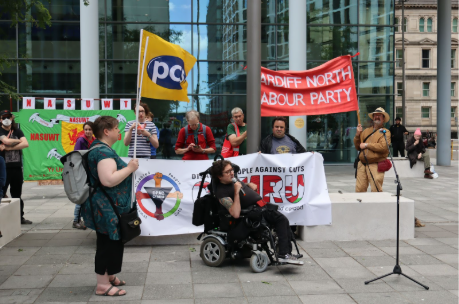
Inside, only a handful of people were supposed to represent the views of 190,000 disabled people in Wales, and the whole process wrapped up just a day before the vote itself.
Starmer, Reeves and the Welfare Secretary Liz Truss clearly thought they could railroad disabled people into accepting huge cuts to their income. But the scale of rebellion from those most affected took them by surprise and led to the biggest crisis of Labour’s term in office so far.
Take Torsten Bell, the Swansea Labour MP and DWP Minister who used to head up the anti-poverty think tank The Resolution Foundation. When he was parachuted into the safe Labour seat of Swansea West last year, he must have felt confident that he could perform an about turn on his previous role and drive through the biggest cuts to disabled people’s living standards in a generation.
Afterall, why else would he have gone onto Newsnight to fully back the reforms, despite being forced to acknowledge that there ‘will be some people who lose out’ and admit that he could not live off £70 per week – the amount that young people would be left with after cuts to incapacity benefit.
To many of his disabled constituents, for Bell to think he could defend making them poorer on national television after counting on their votes only 12 months ago was the epitome of political arrogance.
The spectacle led to the MP becoming a focal point for campaigners.
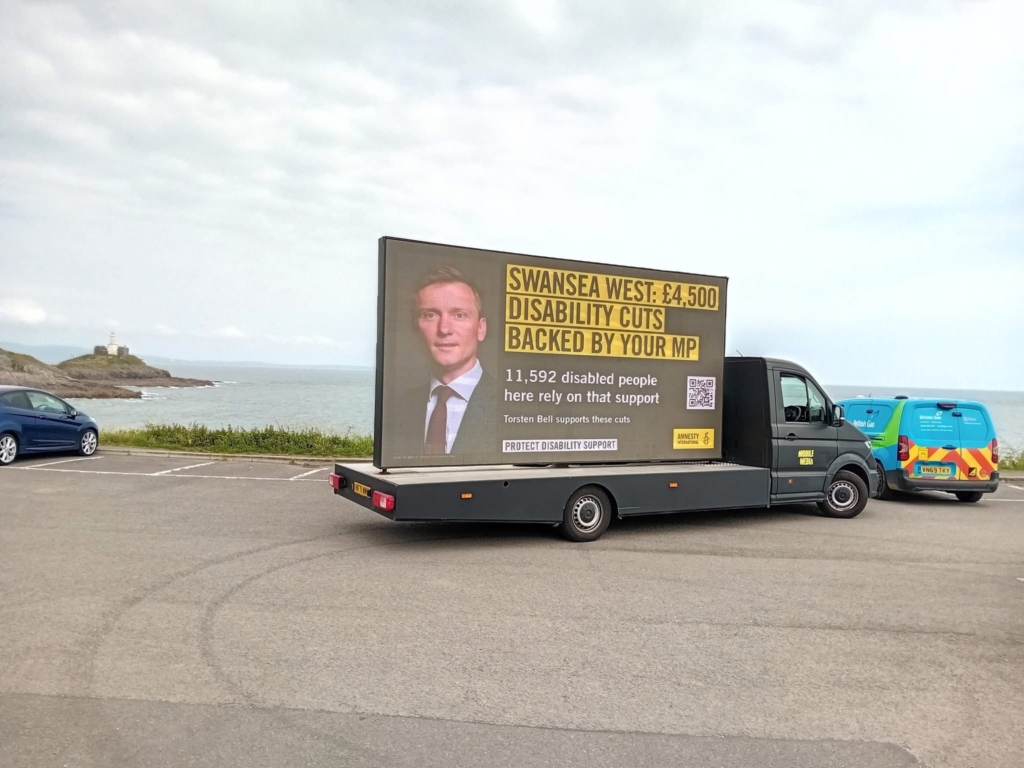
His social media posts were filled with comments from members of the public demanding answers. Amnesty International even paid for a moving billboard to drive along Swansea seafront with a picture of Bell and the caption: Swansea West: £4,500 disability cuts backed by your MP (Pictured, below).
Posters began appearing in the city saying: MISSING: Have You Seen Your MP? (Pictured, main)
Swansea DPAC called him out publicly and challenged him to a debate (which they say he declined). In an open letter that was picked up in the Welsh media, Ben Golightly, of Swansea DPAC, accused Mr Bell of “contradictory statements” about the debate and called on him to answer for his actions and ‘defamatory’ statements about the group. The emails from Swansea DPAC were often sent to scores of journalists, Swansea councillors and Senedd members.
It proved effective and Bell was clearly rattled by the attention, calling the claims against him ‘falsehoods’ and ‘disgracefully untrue.’ In a video posted in June, he even called his critics ‘meme muppets.’
But for weeks Mr Bell refused to back down, displaying ultimate loyalty to Keir Starmer.
Elsewhere, other Labour MPs were also coming under pressure. The Cardiff MP and cabinet member Jo Stevens, also a key Starmer ally, faced protests outside her constituency office and in the city centre.
But a section of Labour MPs – some of whom are disabled themselves – could see the scale of the revolt and an internal rebellion gathered pace.
This ended in the government making two humiliating climbdowns, culminating in Tuesday’s commons vote where Starmer’s authority was completely shredded as he was forced into last minute concessions. And not only has his paper mandate been all but blown away, internal divisions have burst out into the open.
One senior source told the BBC: “The atmosphere in there [No 10] is appallingly bad”, accusing the prime minister of “dumping on people who are a staunch part of the team”.
Coming after the outcry over the cut in winter fuel payments forced Labour to U-turn, protests by disabled people have similarly created a crisis for the government. But campaigners are keen to stress that the fight is not yet over, and are demanding the Bill be voted down on its final reading next week.
Disabled campaigner Ben Golightly says that the watered down legislation still includes devastating cuts to the health element of Universal Credit, and that new claims will see essential expenses cut from £97 to £50 per week from April 2026. He adds that Universal Credit Claimants will still be at least £2,444 a year worse off..
AJ Le Brun, a DPAC Cardiff & Valleys activist, said that the bill had been rushed through with no thought for disabled people.
“The changes and promises made in the final hours before the vote may have soothed the consciences of some MPs, but we see through these shaky promises,” they said.
“The changes to Universal Credit will push more of us into poverty, when we are already struggling with the rising costs of aids and support needed to live with dignity. I do not trust Stephen Timms and his department to conduct a fair PIP review. They have shown us they are not listening to disabled people by only providing one face to face consultation for Wales, and holding the vote the day after the consultation formally closed. What confidence can we have that this review will be any better?
“We welcome a review of the social security system, that is difficult to navigate and fails disabled people at many points, but this bill must be scrapped and any changes must be done with the full cooperation and involvement of disabled people.”
Stephen Timms, the Minister of State for Social Security and Disability who is leading a review of PIP, will likely become a new target for campaigners. He has already come under fire for not acknowledging the failures of the original consultation.
For his part, Mr Bell has said very little in the past couple of weeks, having gone out to defend the government’s proposals only to see them get torn up.
In response to the claims made by Swansea DPAC, a spokesperson for the MP previously told voice.cymru that: “Torsten has been meeting regularly with constituents about proposed changes to the welfare system and will continue to do so – as individuals and as part of groups. Every constituent that has approached Torsten’s office asking for a meeting has been offered one. Torsten is taking the same approach to this issue as neighbouring MPs, complying with strict rules that prohibit MPs from pursuing issues raised by people who are not resident in their constituency.”
voice.cymru asked Torsten Bell for his thoughts following the passing of the watered down version of the bill, and whether he now accepted some of disability campaigners’ criticisms.
He did not reply to a request for comment.
Disabled people in Wales will be protesting in Cardiff on Monday 7th July, 4pm Cardiff Central Library, and in Swansea on Tuesday 8th July, 4pm, Castle Square, ahead of the final parliamentary vote on the welfare bill.