I WAS BUNDLED INTO A VAN AT DAWN DRIVEN TO AN UNKNOWN LOCATION – THE CHILLING ASSAULT ON THE RIGHT TO PROTEST
Two years into Israel’s genocide in Gaza, Western governments are waging a war against their own citizens protesting against it. O Kour spoke to a Palestinian-Welsh activist about her terryfying arrest by plain-clothes cops, and how British authorities are trying to dismantle the growing movement for Palestinian liberation.
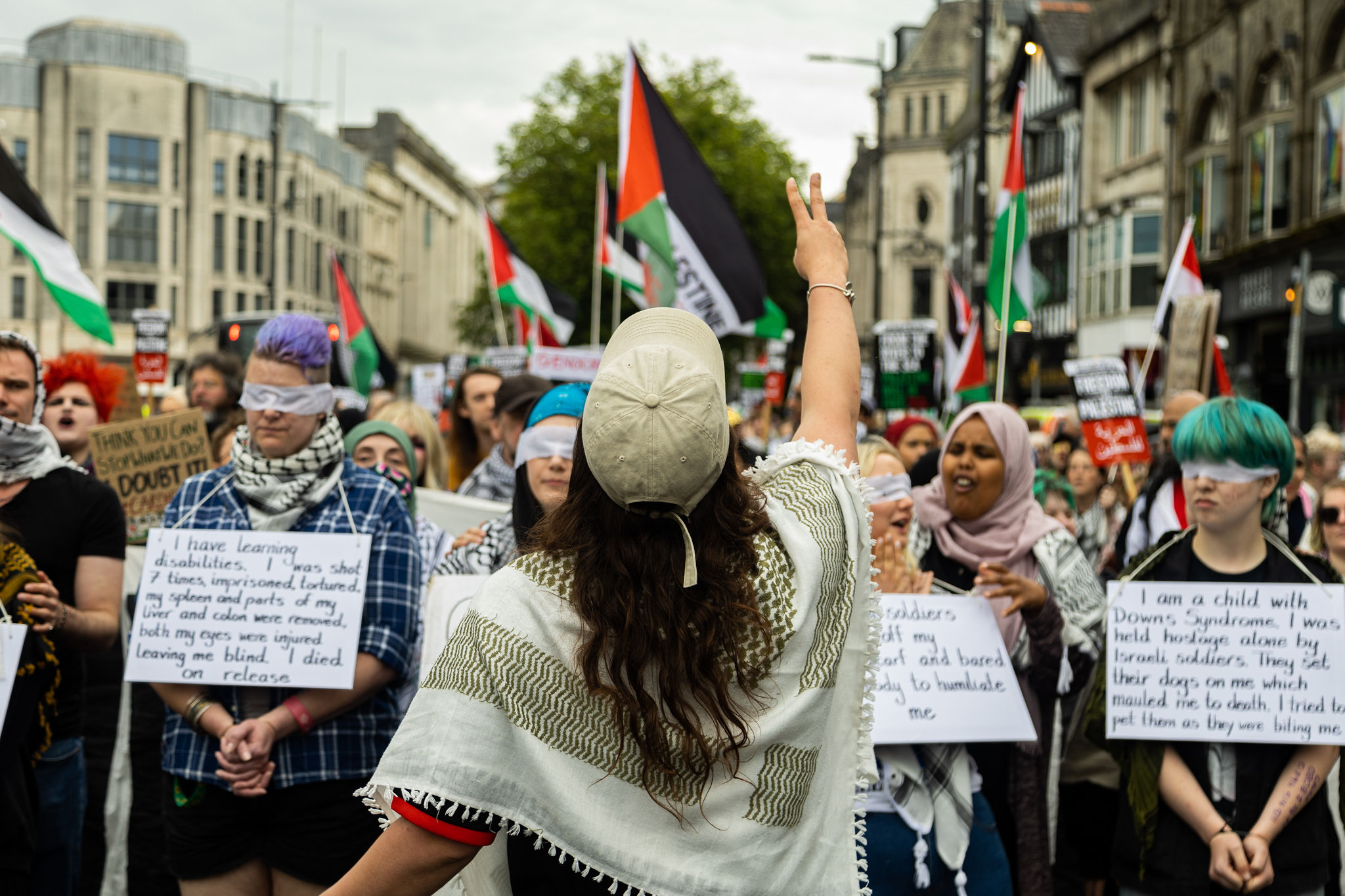
Cover image: Lujane addresses a protest in Cardiff, July 2024. By R Witts Photography Ltd
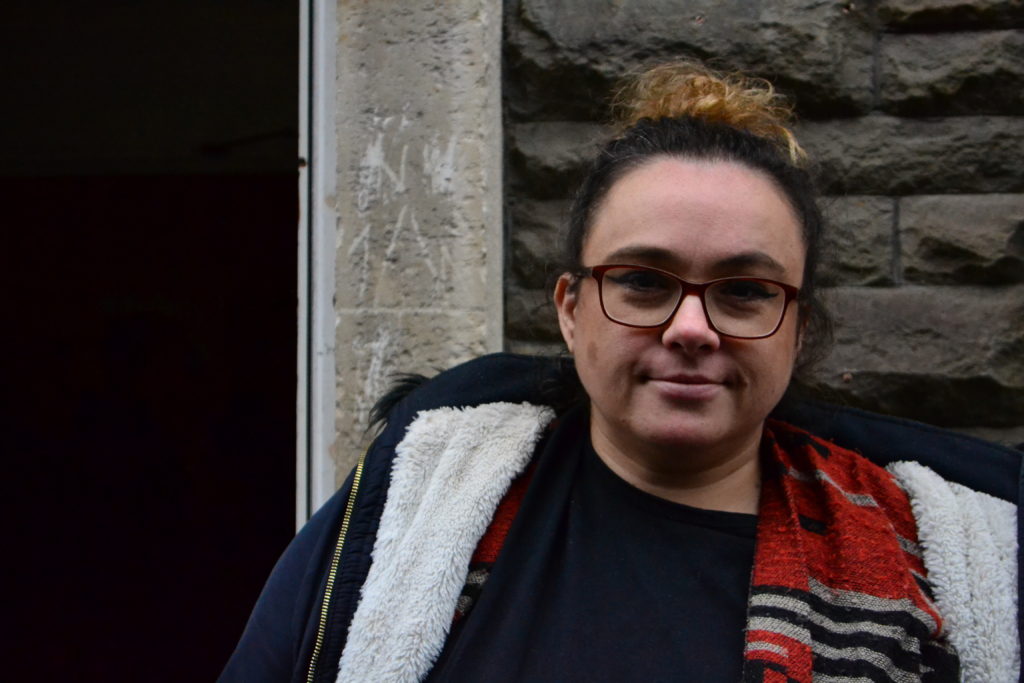
In the early hours of 6 March 2025, three plainclothes British Transport Police officers appeared at Lujane’s door. “They showed up at my house at seven o’clock in the morning,” the now London-based activist tells voice.cymru. “I didn’t think they were the police. They showed me a badge, and I said, ‘How do I know you’re a real officer? Can I see the van, please?’ They said, ‘We’re in an undercover vehicle.’ But how do I know that?”
Lujane: “I was really scared, I was tearing up, and saying, ‘You’re really scaring me, because I don’t have evidence that you’re real police. Can I at least call the police?’ They were like, ‘The police wouldn’t know who we are and what we’re doing here. You need to come with us.’”
Next, Lujane describes how these men entered her home and stood by her bedroom door as she got changed.
“And then I went to the toilet, and they were just standing by the door. One of the officers realised I was really scared, because he then said to me, ‘I know this is scary. Us police officers, we don’t have a good reputation with women’.”
Lujane had no idea where she was being taken, or why. “At that point, I just genuinely accepted that these people might take me, that I don’t know where I’m going to go, and fuck knows what’s gonna happen.”
Only after an hour-long drive across London did she learn what was happening: she was brought in for an incident from a few months ago, when she was chanting pro-Palestine slogans on the London Underground.
This isn’t an isolated case. Netpol’s State of Protest report on policing dissent in Britain in 2024 described “an alarming package of state-supported measures designed to impose social control on protests on a scale reminiscent of the ‘war on terror’ two decades ago”.
More than a year ago, Ayeshah Behit and Hiba Ahmed, constituents of Pontypridd, south Wales, were convicted of harassment by Cardiff’s Magistrates Court for filming and uploading a 20-second interaction with their local MP and Labour minister, Alex Davies-Jones, asking her why she abstained on a Gaza ceasefire vote.
Just hours after posting the video to Instagram, Behit told Netpol that “over a dozen police officers swarmed my door and windows, with several male officers trying to climb in through open windows.” In an Instagram post, she reveals she was left with big bruises after the cops mishandled her and a lot of her belongings were stolen. She was also placed in solitary confinement for 23 hours, Both activists are currently appealing their convictions.
Several activists have argued that this is part of a broader crackdown aimed at suppressing any solidarity with the Palestine movement, accusing the UK government, like its counterparts in the US, France, and Germany, of working to neutralise any meaningful efforts made to challenge the state’s alliance with Israel.
In the last few months, a number of public order laws and counter-terror legislation have been weaponised in order to target activists, whether it’s raiding their homes, seizing personal belongings, or subjecting them to intimidation or violence for peacefully protesting.
Lujane notes an instance where she was going back home at night, and a police officer, out of nowhere, walked up to her and called her by her name. “He’s like, ‘What are you doing here this late?’ Then he tells his friend, ‘This is the girl I was telling you about, who is always trying to tell us that the police are racist. We’re trying to win her over.’ It’s just these little things to intimidate you.”
For Lujane, the goal is obvious: “What they want to do is get to a point where activists can’t even afford to come out. Because you can’t afford another case, you can’t afford more debt,” she says, in reference to the huge cost associated with defending yourself in such cases.
Lujane currently faces four charges and a trial, which is costing her around £10,000 in legal fees — which she is fundraising for on Just Giving. The fundraiser was also shared by Bob Vylan, a punk rock duo who have been in the limelight for their staunch anti-colonial and anti-Zionist stance.
Since Israel escalated its assault on Gaza in October 2023, millions have taken to the streets demanding an end to the carnage — and the UK’s complicity in it. Lujane has been a regular and vocal presence on the weekly protests in Cardiff, and a prominent figure in the movement in Wales. She lobbied her local MP at the time, Alun Cairns in Barry, to demand an immediate ceasefire in Gaza
But the militarised and punitive response from the British state sets a scary precedent for the future, says Lujane. “Freedom of speech doesn’t exist anymore. We criticise a lot of these ‘authoritarian regimes’ — that we call regimes because it’s a colonial notion to call them regimes — but then when we reflect and look inwards at the situation in this country, it’s pretty much the same.”
Even mainstream news publications like the BBC and The Times, instead of performing their responsibilities as arbiters of truth, employ a biased lens on the demonstrations joined by millions. Headlines like ‘The ringleaders behind pro-Palestine protests which left Jews in tears’ risk projecting any criticism of Israel onto the Jewish population, despite Jewish Voice for Peace stating that conflating antisemitism with opposition to Israeli policies or ideology is dangerous.
“A lot of the general public turns to the BBC for the truth,” says Lujane. “When you have the mainstream media omit the truth — lying by omission — that completely shifts the way people think. Had the BBC recognised its duty to get the truth across, the last two years would have been dramatically different, the outcome of protests and the level of pressure on the government would have been different. The majority of people who don’t know enough about Palestine would have learned and come to the realisation that what’s happening is a genocide.”
However, the cultural and political landscape is slowly shifting. In the last two decades, the Boycott, Divestment and Sanctions (BDS) movement has resulted in several governments severing diplomatic ties with Israel, implementing arms embargoes, and divesting from Israeli institutions that practice trade on stolen land.
“After two years of rage, enough people have come to the realisation that what’s happening is wrong”, says Lujane. “Journalists are waking up to the fact that they’re soon going to be in a position where they’re completely discredited. It’s becoming common knowledge that what’s happening is a genocide, it’s ethnic cleansing.”
But Lujane doesn’t believe this moral shift stems from a clean conscience. “It just comes from the fact that too many people are now holding them [journalists] accountable, and they need to make sure that they’re safe in their future career.”
She points to the assassination of Palestinian journalist Anas Al-Sharif as a turning point. Al-Sharif was killed in an Israeli airstrike that targeted a media tent outside Al-Shifa Hospital in Gaza City.
“Look at Clarissa Ward calling Anas Al-Sharif a colleague, when she was one of the first people who facilitated all the lies that CNN had created in the very beginning of the genocide. It’s not going to benefit her anymore. Her career is going to be completely on the line. She’s already discredited, so she needs to make up for it as soon as she can.”
As media narratives fracture, the movement continues to grow. In London last month, nearly half a million demonstrators marched in support of Palestine — dwarfing the far-right rally led by Tommy Robinson in September. Despite the ordeal she has been through, Lujane is not backing down.
“I’m not just pro-Palestinian; I’m anti-Zionist,” says Lujane, defiantly. “One is your love for people, and the other is challenging what harms them. It’s identifying how Zionism has benefited from apartheid South Africa, South Sudan militias, selling surveillance to EU borders, and selling drones to other countries.
“When you address the root cause, and you’re breaking down 150 years of propaganda, you become an enemy of the state. You become an enemy of the structure that is holding up this imperial power.”
And every day, more and more people up and down the country are becoming aware of the horrors unfolding in Gaza and the West Bank. “In the beginning, people were very sceptical of direct action. Now it’s the most essential way in which we can financially impact or stop the selling of arms,” Lujane explains.
Still, the genocide continues. The so-called ‘ceasefire’ announced on 10 October by none other than Donald Trump has been violated by Israel at least 282 times since, injuring and killing close to a thousand Palestinians.
But the Palestinian cause is gaining unprecedented momentum around the world, and that’s because more people are realising that the entire movement isn’t just about liberating Palestine. “This is about liberating all systems of oppression,” says Lujane. “Israel is a colonial outpost, and when you expose them, that is the beginning of the end.
*Some reporting restrictions apply due an ongoing legal case