“If I hadn’t picked up, she’d probably be dead” – The Welsh charity left to pick up the pieces of a broken system
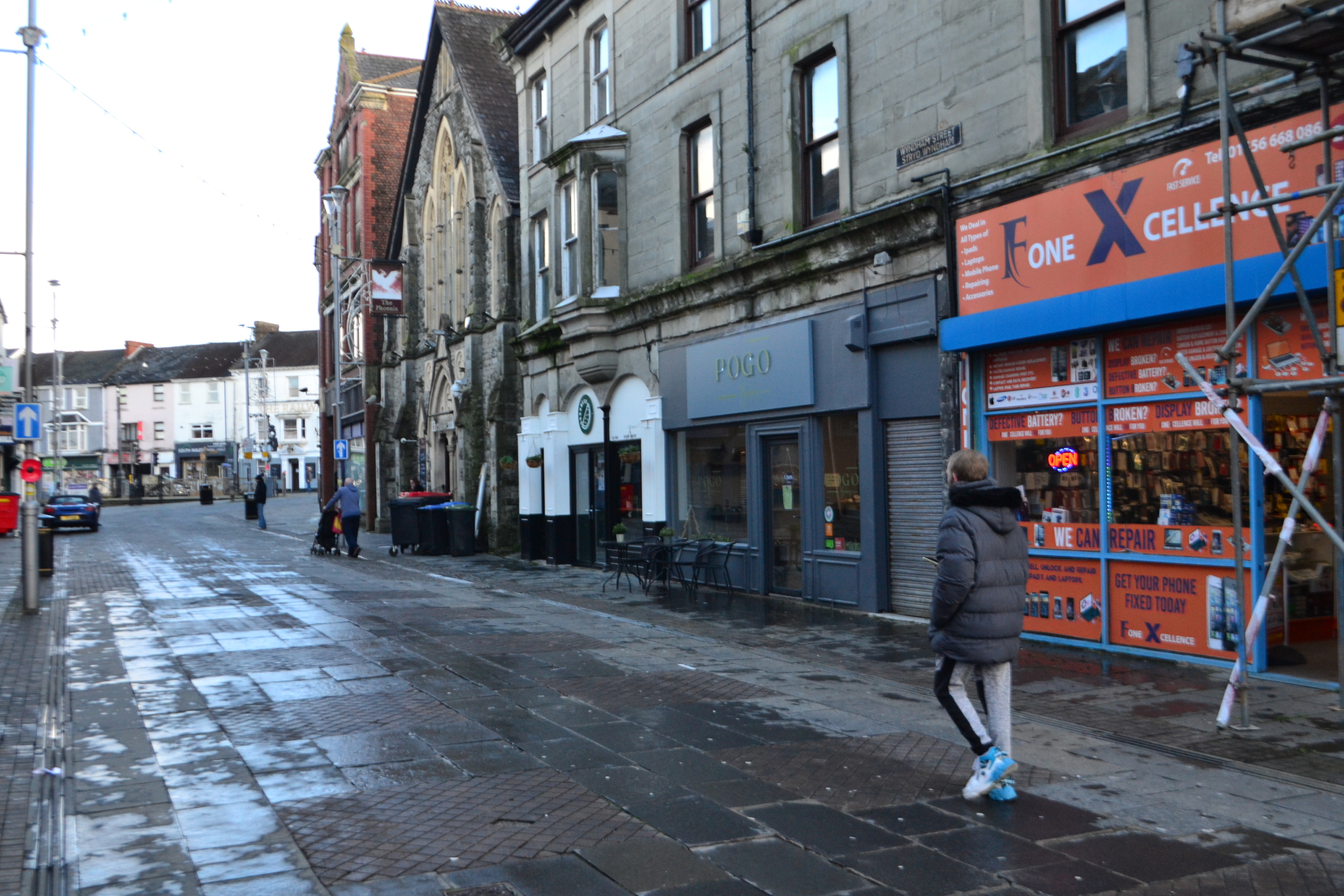
Words and images by SC Cook. Cover image, Bridgend town centre.
In the town of Bridgend, south Wales, life for far too many people is being lived on the precipice. It was here that only a few weeks ago a woman phoned the police to report she had been violently assaulted by her partner at home, and had decided to flee.
The police found a place for the woman in a safe house over 200 miles away, but the train lines were flooded and she couldn’t get there. Then the safe house found out the woman was a prison leaver on probation, and said that they wouldn’t take her anyway.
It was a Sunday and there was no emergency domestic violence service in Bridgend that could help. So the police were about to send the woman back to the house where her abuser was, a man who had just violently assaulted her.
At that moment Rebecca’s mobile phone rang. She was off work and at home with her family, but she decided to pick up anyway. It was the officer dealing with the case. Could Rebecca find somewhere for the woman to stay?
“If I hadn’t picked up that phone call, she’d probably be dead now,” she says.
We are sitting in the offices of the (Bridgend Adult Resource Centre) BARC, a small, self-funded charity that supports the homeless and people who are in need of support. Rebecca is recounting the case from behind her desk, with two of her colleagues, Scott and Hannah, also in the room. I am not actually here to talk about this case specifically. It just comes up as an example of how precarious the situation is here for people who’ve slipped through whatever’s left of the social safety net.
Bridgend Council’s own domestic violence service has a domestic abuse suite, but according to Rebecca it doesn’t operate over the weekend. “People don’t get abused on a Sunday, apparently,” she says sarcastically.
“The police were told, ‘Well, find her somewhere or take her home to the man who’s just caved her skull in.” This is when they called Rebecca, who managed to find a hotel where the woman would be safe.
In another case that further highlights the alarming lack of support for women fleeing domestic violence, the charity took another survivor to the council-run domestic abuse service on a Friday, explaining that she needed a safe place immediately. But they were told that because it was a Friday, the woman would have to wait until Monday before the council could do anything.
“She was a domestic abuse victim and she had just been violently attacked…but they [the council] couldn’t put her anywhere safe, they said they didn’t have anywhere,” Rebecca explains.
The charity found the woman a safe place and paid for it with their own money. Their funding only comes from donations, a charity shop and some National Lottery grant money. But when BARC asked Bridgend council to reimburse them the cost of the accommodation, given they are responsible for domestic violence services, they refused.
“The council’s justification for not paying the money was that it was our decision to house her, not theirs, so we had to pay for her. So what was I gonna do then, send her back to him?”
These cases are not out of the ordinary for the charity, in fact a lot of the people they support are victims of domestic violence whose situation is compounded by the lack of available housing and accommodation. And neither is it unusual for BARC to come up against Bridgend Council in their attempt to get people urgent support.
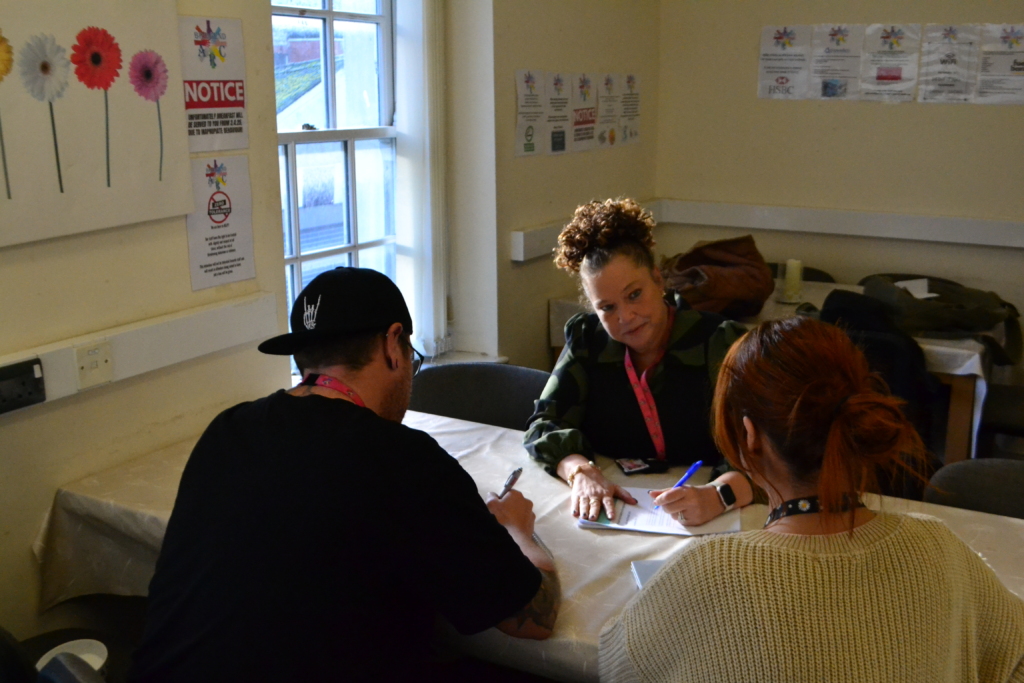
We are in their small office, on the first floor of a building just off the high street. Downstairs is a drop in centre for anyone to come in and use throughout the day. There people can find free tea and coffee, a TV to watch and a warm place to sit. They also provide two free meals a day for anyone who needs it, no questions asked.
I’m sitting down with Rebecca, Scott and Hannah, the three staff who keep the centre running alongside a team of volunteers. At one point, Rebecca’s mum pops her head round the door to ask a question about the lunch menu. It turns out she’s a volunteer chef for the day because the usual cook couldn’t come in.
But the original reason I came here was to talk about a viral post on Facebook concerning a woman called Tina.
Tina is in her sixties and her life began to spiral after she was forced to leave the council house where she had been living. She soon became homeless and ended up in prison for a brief period. After this, she found her way into a homeless hostel but, according to Rebecca, suffered from financial abuse and was evicted after an altercation with another resident.
From there, Tina lived in a tent on a busy roundabout, where she was sexually assaulted. A man has been arrested in connection with the incident. Tina was then in hospital for a short while, trying to stay as long as she could because there was nowhere else to go. Finally, she got in touch with BARC, who made an application for housing assistance with Bridgend Council. Making these sort of complicated applications, or helping with benefits, is a large part of what they do.
But the council refused to take responsibility for Tina, and she was again facing the prospect of being homeless. “They’ve said that because she was put in the hostel and then removed, they don’t actually have a duty of care,” Rebecca tells me. “They’re saying it’s her own fault.”
“She’s lived in Bridgend all her life. I mean, I know she’s a chaotic person but at the end of the day, she’s 65 and about four foot ten. She’s not a physical threat.”
After feeling like there was no other option, and with her consent, the charity went public with Tina’s story and published a Facebook post decrying the council’s decision. The post blew up and was shared almost 800 times. But whilst it publicised Tina’s case and drew in media attention from the BBC and others, it didn’t change the council’s decision.
When a further application was made, a second rejection letter came back.
“The council is not under any duty to accept your new application for housing assistance,” the letter stated. “Nor are we required to provide temporary accommodation. There is no statutory right of review to this decision.” The letter signed off by giving the address of the housing charity Shelter Cymru in Swansea, 24 miles away. “Let’s be honest, if she has to sleep on the streets she’s not gonna make New Year, is she?” Rebecca told me when we spoke before Christmas. “She’s 65 years old, she’s unwell. It’s gonna be catastrophic.”
“And who’s gonna be held responsible for that?”, she asks. “Because it isn’t going to be me, because I’m going to be shouting so loud everybody’s gonna know.”
Thankfully, Tina did not sleep on the streets over Christmas and New Year after BARC secured somewhere for her to stay for the foreseeable future. The whole case highlights the steady erosion of core services within local authorities, and how these are being picked up by a patchwork of small organisations that are heavily under-resourced.
Does it ever make you feel positive, being able to help people, I ask?
“Yeah, yeah,” Rebecca says, slightly unconvincingly. “But then you also go home at night and you think of the ones you can’t help, and you know that they’re on the street.”
“Like last night it was freezing and I had my fluffy pyjamas on in my bed, my heating on and I was still freezing. And I’m thinking I know I got at least six or seven boys out there in a tent.” At this point, Rebecca’s colleague Hannah chimes in. She recalls how only recently she met what she thought was a teenage boy sleeping on the streets near the council offices. “He looked so young and he was sleeping behind the hostel in a tent or whatever,” she says.
“It’s dire in Bridgend, well it’s dire all round to be honest,” says Scott. “In the last two years we’ve probably doubled, maybe tripled [the number of people needing help].”
The most recent figures for homelessness in Bridgend back this up. At the end of 2024, homeless applications made to Bridgend council had gone up by around 20% on the previous year. Temporary accommodation placements had shot up, with a 200% increase over a four year period. Demand for social housing has also increased, from 816 people on the housing register at the end of 2020, to 3254 people at the end of 2024.
“There’s a housing crisis everywhere but I think the housing crisis suits the government to be honest. I can’t go into politics, but the rich get rich and the poor get poorer,” Rebecca says.
The centre is struggling to meet the demand and the crisis is not confined to housing either. Hunger and poverty stalk the streets here, too. The centre provides around fifty free meals a day when it’s open, and also does discounted food bags at £3, £5 and £10. They’re also able to issue gas and electric vouchers, and discretionary funds.
“The statutory places where they should be going basically palm them off on third sector people like us,” says Rebecca. “It’s quite unfair because we’re not funded. We’re a third sector organisation, most of us are volunteers here and you know, we’re bearing the brunt of it.”
The year ahead shows no sign of the pressure easing off. BARC has plans to open a new centre in Maesteg, a former industrial town at the top of the Llynfi valley. This will be oriented around the needs of families and children, a demographic that they struggle to cater for at the moment.
“The system is broken,” Rebecca says. “There’s no point trying to repair the system; it needs a complete overhaul. It needs to be new.”
voice.cymyu contacted Bridgend council, asking about the level of domestic violence support and Tina’s case.
They told us that while their Assia Domestic Abuse Service is only open between 8.30am-5pm Monday and Friday, they do have specialist advisors available 24/7 who can assist with access to emergency accommodation.
With reference to Tina’s case, a spokesperson for the council also said that “the full details have not been made public, nor have they been shared with BARC.”
“Only in the most serious of situations would we ask someone to leave temporary accommodation, and even then, we approach partner organisations on their behalf to try and help them find alternative support.
“Such actions are always a last resort and are only taken in the most serious situations.”