In Cardiff, Journalists Hear What It Means To Be A Reporter Amidst A Genocide
Journalists and media workers came together to lament the silencing and dehumanisation of their colleagues in Gaza and the West Bank, bringing Palestinian voices to the forefront
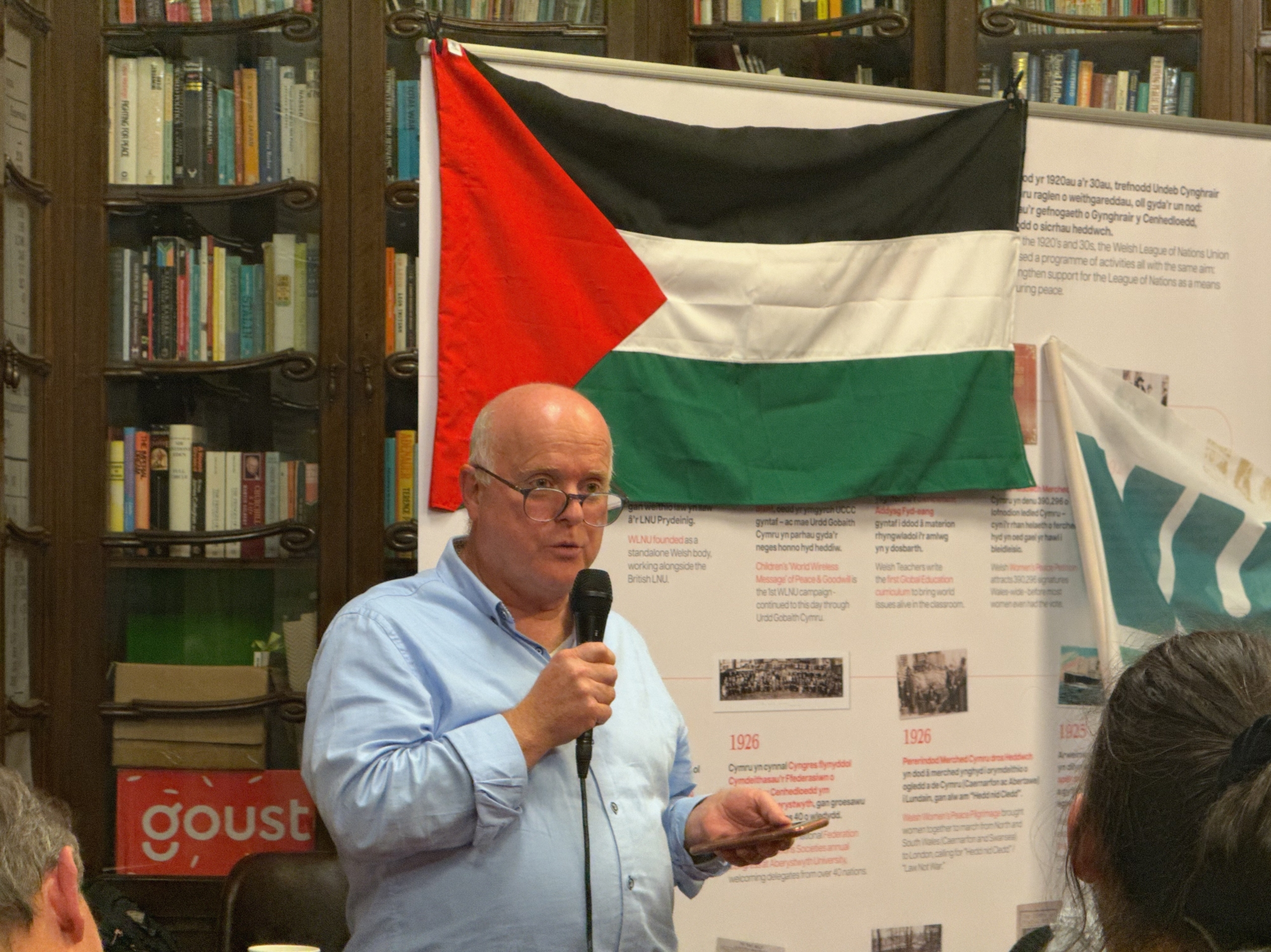
By Adwitiya Pal. Cover image, Andrew Draper from National Union of Journalists Cymru addresses the event, by Adwitiya Pal.
With Israel continuing to kill Palestinians and restricting aid supply despite the US-administered ceasefire, journalists from Wales and the rest of the UK came together to reflect on what it means to be a reporter amidst a genocide.
In the last two years, more than 300 journalists and media workers have been killed in Palestine, many of them victims of direct targeted attacks by the Israeli Occupation Forces, according to the data analysis website Shireen.ps.
To condemn these appalling attacks that have claimed not only over a quarter of the media professionals risking their lives to show the ground reality in Gaza, but also countless civilians who have shared important information and footage on social media, the National Union for Journalists (NUJ) organised the event “Reporting Gaza: Work, Life and Death” in Cardiff earlier this week.
The union, alongside the International Federation of Journalists (IFJ) and the Palestinian Journalists Syndicate (PJS), has condemned the killings and launched an investigation into the deaths and injuries sustained by media workers in Gaza, the West Bank, and Lebanon to demonstrate clearly the systematic and targeted nature of the attacks, which constitutes a war crime under the Geneva Convention.
“Our main aim was to provide an educational event,” Andrew Draper, member of the South Wales branch of the NUJ told voice.cymru. “We did some fundraising for the IFJ Safety Fund, but the main aim of it was to reach as wide an audience as we could, to allow Palestinian journalists to tell their story, and to get it out there about what is happening, because not everybody realises what’s happening.”
He added that the union’s National Executive Committee ultimately plans to use this research to feed into the case lodged against Israel and its officials like Benjamin Netanyahu, Itamar Ben-Gvir, and Bezalel Smotrich, at the International Court of Justice (ICJ) and the International Criminal Court (ICC).
Israel has been attacking and apprehending Palestinian journalists long before October 2023. Shireen Abu Akleh, a prominent Palestinian-American journalist who worked as an Al Jazeera reporter for 25 years, was shot and killed by Israeli forces in the occupied West Bank in 2022 while wearing a blue press vest.
However, its assault on media professionals dramatically escalated from 7 October 2023, killing Palestinian photojournalist Mohammad Al-Salhi, shot dead while covering Israel’s military assault in central Gaza, and Ibrahim Lafi from Ain Media news agency, killed while reporting near Beit Hanoun checkpoint in northern Gaza.
Despite the death toll rising since then, former UK Foreign Minister David Lammy claimed that “there are no journalists in Gaza” last year.
“That’s totally denying the existence of hundreds of Palestinian journalists working there,” Andrew said. “What we hope to achieve is to build awareness of what is happening, so that the world knows what Israel is doing.”
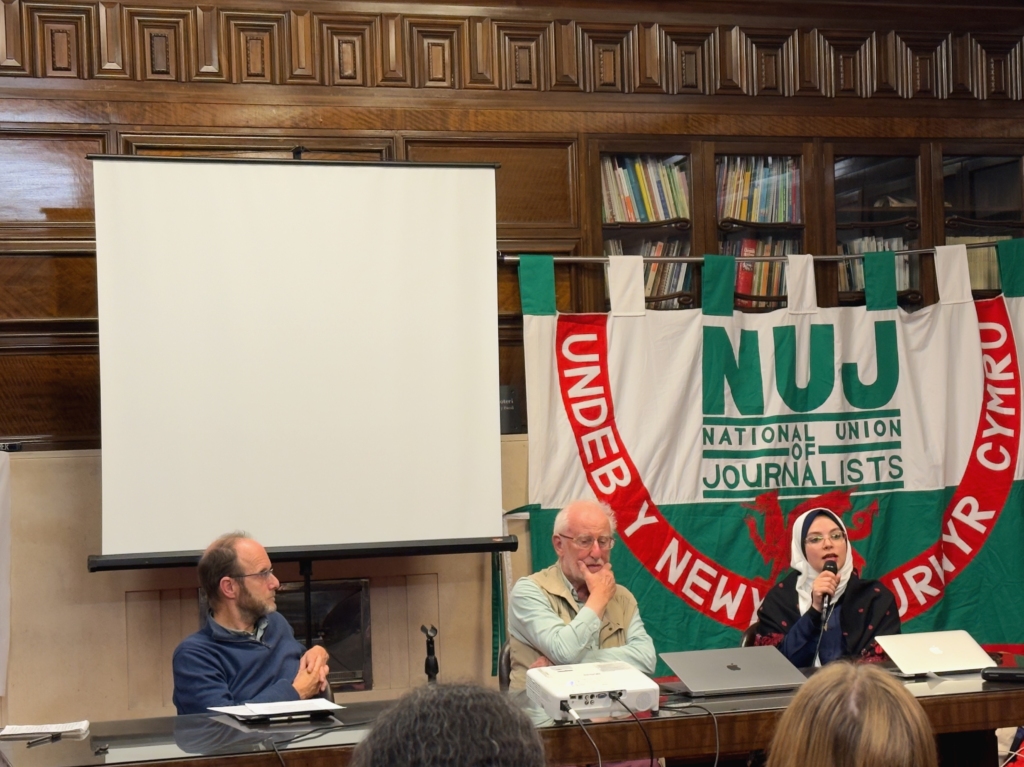
The event comprised of talks from Hala Hanina, a Palestinian from Gaza, and Jonathan Cook, a British journalist formerly based in Nazareth, alongside screenings of documentaries from Mike Joseph, a Welsh Jewish journalist, broadcaster and genocide scholar, and Claudio Laurini, a journalist and producer.
The short documentary The Concrete Between Us, shot and directed by Claudio in 2019 in the West Bank, was made while he was studying for a postgraduate degree in journalism at Cardiff University. It focuses on the towns of Hebron and Qatanna in the West Bank, showing how Israeli settlers encroach on the territory while abetted by the military forces, forcing Palestinians to live like prisoners in their own land.
Hala, a PhD researcher at the University of Newcastle and activist, stressed the importance of listening to Palestinians, whose voices have continued to be silenced, ignored or superseded by Zionist claims.
“The British media talks about truth, fairness and objectivity all the time, but what is more true and objective than raw videos, images and the livestreams being shared by the people of Gaza?” she said. “Is that not objective enough for the western media?”
She recited an article by Palestinian journalist Shaimaa Eid, which demonstrated how, amidst genocide and famine, the profession that she once loved was reduced to a means to get a loaf of bread for her family.
“We, who once reported on the suffering of others, have become part of that suffering ourselves,” her article read. “We write while suppressing our own pain and hunger, struggling to keep the words from collapsing before they reach the world – to show just how deep our oppression runs.”
Eid wrote: “The cameras and equipment we once saw as extensions of our very souls have now become burdens we sell to secure food for our parents and children.
“One of my fellow journalists offered his entire archive – twenty years’ worth of photos documenting life in Gaza — in exchange for a single bag of flour.”
Hala herself, who moved to the UK before October 2023, has seen more than 400 people she knew in Gaza killed since then. She ended her powerful talk by calling for an end to the dehumanisation of Palestinians that has been enabled by the western media.
Mike Joseph, descendant of Holocaust survivors who found refuge in Cardiff after fleeing Berlin in 1939, has made three documentaries interviewing Sami Abu Salem, a Palestinian journalist.
In his latest film, released earlier this month, titled After that we can rebuild everything, Joseph asks Abu Salem what reporting from Gaza means to him, to which he replies: “Media is a weapon, that’s why Israel prevents foreign journalists from coming to Gaza. They say that the Palestinian journalists are liars, they exaggerate, not accurate, fake news… okay, let the foreign journalists in Gaza. But they refuse that. That’s a signal that this ceasefire is fragile.”
Another question that Joseph poses to Abu Salem is what the British people and the government can do to seek justice for Palestinians and help them rebuild. He answers: “Please put pressure on Israel to allow more food aid. Implement the international law at the ICC and the ICJ. Don’t give Israel political immunity… the UK and the US are strong shields that this Israeli extremist government is using to protect itself from international law. So please strip them of this shield. Let law be implemented.
“Please help us in strengthening the ceasefire, and don’t let the IDF and Netanyahu violate it. Help us rebuild the future of our kids by rebuilding our schools, hospitals, and infrastructure. Help us get rid of this hatred… help us rebuild our dreams, because my kids are now just thinking of escaping from Gaza.
“Help us to go back to our homes,” he continued. “Before 7 October, we had dreams to return to our houses in Beyt Tima and Burayr. Now our dream is to go back to Jabalia. In the future, if the Israelis [continue to] violate the ceasefire again, maybe we’ll be kicked to Rafah to the south, and our dream will be to go back to Gaza [City]. So after decades, the dreams are reduced.”
The final speaker of the evening was Jonathan Cook, winner of the Martha Gellhorn special award for journalism, who shared some damning tales about the British press from his time reporting from Nazareth, involving pushback from The Guardian about an exclusive investigative report covering the assassination of British UN official Ian Hook by an Israeli sniper in Jenin in 2002, which ultimately appeared as a chop job when it was published in the paper.
The event, held at the Temple of Peace — originally constituted to be a site of justice and remembrance, even serving as Cardiff New Synagogue from 1948 to 1952 — was brought to a close with a Q&A panel with the speakers and a closing note from Andrew Draper, who highlighted the courage it takes to be a journalist in Gaza, where “nowhere is safe” and every move is closely followed by the IOF.
The NUJ aims to present its collected data about the killings of journalists by Israel to the UK and Irish government, and use them as “grounds for an immediate suspension of arms sales to Israel, in fulfilment of its obligations to respect and uphold international humanitarian law, including the protection of journalists.”
The union also intends to warn the British government that if it does not refrain from describing Israeli military activity in Gaza as “legitimate self-defence”, it risks being found complicit in war crimes. It’s going to continue its campaign for international journalistic access to Gaza and to ask the Netanyahu government and its apologists, “What does Israel have to hide?”