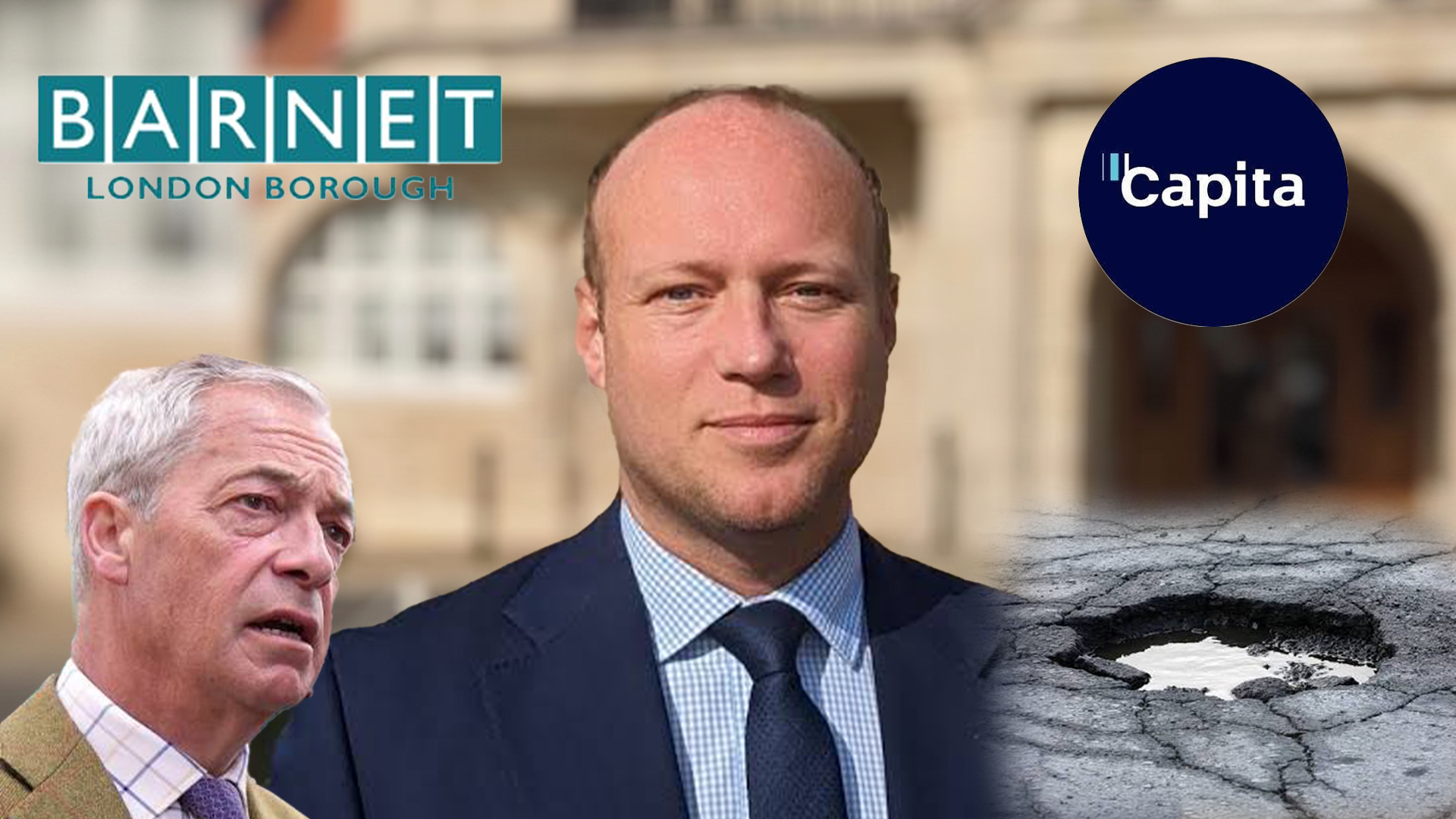
REVEALED: The Truth Behind Reform Leader’s Tory Council That Turned Into A Disaster For Locals
Reform UK’s leader in Wales, Dan Thomas, was a core figure in the disastrous Barnet experiment, where millions of public money was handed over to outsourcing mega-firm Capita.
Thomas was a leading member of the Tory council from 2011 and one of the biggest advocates of the so-called Easy Council, where almost everything was sold off.
Capita were allowed to make huge profits, in one case by forcing disabled people out of supported accommodation and selling off core services, including domestic violence support.
Union Rep John Burgess: “Dan Thomas represented a new breed of Tory…and I would say that he was really aggressively anti-union and was very arrogant.”
By SC Cook
Who is the Reform UK leader in Wales, Dan Thomas? This is a question that many people will be asking ahead of a crucial Senedd election on May 7th.
Thomas, who was selected by Nigel Farage earlier this year to be the party’s frontman in Wales, was previously the Tory leader of Barnet Council in London. In fact, Mr Thomas spent almost two decades as a Tory politician in London prior to moving over to Reform.
There are many things to say about Reform UK, particularly the credible accusations of racism that were only strengthened this week when one of the party’s most prominent politicians, Aaron Banks, publicly questioned whether a Black person from Butetown, Cardiff could ever be considered Welsh. Anti racist campaigners have also warned that a high Reform vote could open the door to anti-migrant racism and violence in Wales.
However, this investigation deals exclusively with the record of Reform UK’s leader in Wales when he was a key member of the Conservative administration in Barnett Council.
voice.cymru has spoken to the journalist who reported extensively on Barnet council at the time, and has interviewed a leading trade unionist whose members lost hundreds of jobs to the privatisation championed by Dan Thomas.
We have also gone back through historic blog posts by local resident John Dix, and delved into a new report by UNISON Cymru Wales, which details the disastrous effect of handing hundreds of millions of pounds of public money to one of the UK’s biggest outsourcing firms.
Now, Mr Thomas is far from alone when it comes to being a prominent Tory now filling up senior positions within Nigel Farage’s party. Some of the most notorious political figures from Rishi Sunak’s deeply unpopular Conservative Government,, from Suella Braverman to Robert Jenerick, have been welcomed with open arms by Reform UK.
For a party claiming to be anti-establishment, Reform UK now has several politicians who have ruled directly as part of Britain’s political elite.
Dan Thomas appears to be no exception. First elected in 2006 as a Tory Barnet councillor, he quickly rose through the ranks and became a cabinet member from 2011 until 2019. After this, he was the leader of the Conservatives on the council before voters finally kicked the party out in 2022. As the Tories became an electoral liability, Dan Thomas moved over to Reform.
But for many residents, Mr Thomas didn’t seem to govern on behalf of the people of Barnet, but rather for a shady and secretive outsourcing firm called Capita.
This is because Dan Thomas was an integral part of the Tory leadership that handed almost £750 million of public money to Capita over a 10 year period. This was done under a model that became known as the “easy council” which oversaw one of the biggest outsourcing programs from public to private ever seen in the UK.
Speaking to voice.cymru, the journalist Aditiya Chakraborty, who wrote extensively about Barnet council, described the situation at the time:
“You have a new Prime Minister, David Cameron, you have a new Chancellor, George Osborne, and together they’re talking a lot about something called austerity, about cutting public spending, about cutting what the state does. And then in North London, you have this local authority, Barnet, which sets about very conveniently talking much the same way about how it can radically reshape what the council does for residents.”
“So you have this council which was willing to act basically as the pioneer of austerity in one borough… and the story of the easy council was effectively that an awful lot of those services went to one big company called Capita.”
Of course, even developing this model came at a huge cost, with management consultants paid millions just to come up with the ‘easy council’ idea.
As all of this was unfolding, one resident who immediately thought something was suspicious was a local blogger called John Dix, who seemed to have no political agenda other than trying to make sure that public money in Barnet was being spent for the benefit of local people.
He wrote under the blog name Mr Reasonable and stated that he was simply “standing up for common sense in New Barnet.”
Over several years, Dix was able to scrutinize the spending of public money going towards major consultancy and outsourcing firms, in particular the FTSE 100 company Capita.
Despite attempts to stop him asking difficult questions and bar him from meetings, Mr Reasonable uncovered a steady stream of dubious financial accounts which just so happened to line the pockets of some of Britain’s richest people, seemingly at the expense of local people.
It was Dix who revealed in 2018 that Capita retrospectively charged Barnet council £453,580 for routing library calls through a Capita call centre. After some analysis of call volumes he worked it out at a charge of just over £8 per call, being effectively billed back to residents and into Capita’s bank account.
Interestingly, another area affected was potholes. Long before potholes were such a major problem in all parts of the UK, Barnet Council seem to have led the way when it came to the issue. According to reports at the time, this was because Barnet Council outsourced pothole repair to a private firm and sacked all of their own inspectors. This meant that the private firm responsible for fixing potholes, which had a financial incentive to save as much money as possible, was also allowed to inspect their own repairs with no independent oversight.
As such potholes became so bad that residents of one street even complained that they couldn’t sleep at night because of the noise of cars hitting the holes.
Another bizarre side effect of the Tory council that Thomas helped to lead was that it outsourced all of its call centers for residents to different private firms scattered across the rest of the UK. This meant that local people had to speak to call centre workers who, through no fault of their own, knew nothing about the local area and all the services they were supposed to be discussing.
Payroll for what remained of council staff went to Belfast, while for schools it was Carlisle. Pension queries went to Darlington. Benefits ended up in Blackburn. Parking notices came from Croydon. Calls to the local library were first directed to Coventry. Even births, deaths and marriages were managed in Brent.
It was hard to see how this benefited local people at all. One woman had wanted to put up a bench in memory of her deceased parents at a local hill. But the process of contacting the council for this service, which should have been relatively straightforward, became a total nightmare. The call center employee had no idea about the hill or location where the woman wanted the bench to go and had no idea how to process such a request, and in the end the woman gave up.
Another case involved a sick woman who had been sent a bill for council tax arrears which was overestimated by thousands of pounds. But privatised call centres often impose targets on workers which means they’re encouraged to finish calls early, and in this case the person on the other end of the phone refused to acknowledge the issue, forcing the local resident to take the case to court at great expense and personal cost.
But as well as running a service which was seen by many local residents as completely dysfunctional, where speaking to a real person was almost impossible, Capita also charged for so-called extras.
So as well as the costs that they would charge for the contract of say, telephone services for local residents trying to get hold of the council, they would also charge additional costs for so-called added services that they have provided. In 2018, this took the form of a £250,000 additional charge on top of an already lucrative call centre contract (Capita charged the council around £8 per minute on calls made to library services by local residents)
When local blogger John Dix looked into this, he found these additional charges appeared to be related to time spent talking to a virtual agent, i.e not a real person. This seemed strange because the whole point of an automated call operator (which many people in the modern world have come to utterly hate) is that you don’t have to pay a human a real wage.
Capita, under the model championed by Mr Thomas, were charging the people of Barnet a quarter of a million pounds for the privilege of being left on hold speaking to a robot.
Of course, none of this would have happened had the council employed staff not been sacked and replaced by cheaper workers elsewhere. voice.cymru spoke to John Burgess, who was the Branch Secretary for the trade union UNISON in Barnet representing thousands of these workers.
“There were hundreds of redundancies. It was the biggest redundancy I’ve ever had to deal with. Most of the jobs were shipped to other parts of the country.”
Burgess recalled Dan Thomas’s role in this ‘failed experiment’:
“He promoted an ideological message that privatisation was the way forward. Dan Thomas represented a new breed of Tory…and I would say that Dan Thomas was openly anti-union, really aggressively anti-union. He had a very set view of us and was very arrogant.”
But then there was the issue of how these outsourcing contracts treated some of the most vulnerable people in the borough, and even made money off them.
As John Dix uncovered, Capita even made a profit when people with a disability or additional needs were moved from supported accommodation run by the council into private housing in order to save the council money.
With no regard for what the service users actually felt about the move, Capita claimed that it saved the council around £197,000.
But because of the contracts that were drawn up under the Tory administration, Capita were entitled to a portion of the savings. So after having forced people with disabilities and additional needs into private housing, Capita claimed that their share of the savings amounted to £67,000. Barnet council happily obliged and paid up.
“This makes me very uncomfortable,” wrote Dix at the time, “because it turns vulnerable people into a commodity on which a profit can be earned. This isn’t about effective procurement, it is about cutting a service to make money.”
There were other examples of this practice taking place, where Capita would effectively top slice a huge chunk of the supposed savings they had made by selling off services.
With domestic violence services, which covered everything from funding of refuges for women seeking safety to support services for survivors, Capita claimed £47,000 after selling it off to a private provider. This is money that could have gone back into supporting women fleeing domestic violence.
“Again, what seems to be missing from the process is the issue of quality and user satisfaction with vulnerable people being a source of profit for Capita,” wrote John Dix.
There are countless examples of this so-called ‘gainshare’ approach, where Capita ‘shared’ some of the ‘gain’ (savings). When Barnet council increased their Council Tax revenue by £315,000, Capita took a whopping £177,000 for themselves, partly through charging for their own consultants, some of which were on £1,300 a day.
Much of their profits came from simply selling off any service they could to the lowest bidder and then taking a huge slice of the so-called savings.
The overall picture is clear: that selling off public services was seen as an end to itself and was deeply ideologically driven. Even when the effects were clear and damaging, they stuck to the model almost religiously.
This in itself is particularly odd given that in his party’s manifesto for Wales, Dan Thomas says Reform wants councils to “rebuild in-house capability and stop outsourcing core functions”.
But his political record tells a very different story. Is this another case of a politician saying anything to get in power then doing exactly the opposite when they’re there?
In the end, the Barnet experiment tells its own story. The headline figures for Thomas’s time Barnet Council are striking, as the UNISON Cymru report details.
- £500 million in decade-long Capita contracts signed in 2013
- 790 jobs transferred into the private sector (hundreds of workers in Barnet were effectively sacked)
- £229 million over budget
- Two frauds totalling over £2.1 million, both linked to outsourced operations
- First local authority to be fined by the Pensions Regulator under the outsourced
- arrangements
- Services scattered across Darlington, Carlisle, Belfast, Croydon and Coventry
Barnet Council has been described as a failed experiment for an ideology hell bent on maximising profits at all costs and always believing that privatisation and outsourcing is best, regardless of the evidence. In some ways, you could argue that the Barnet model was a more extreme version of what was happening across local authorities during the period of major austerity and cuts.
Many of the things that people are so fed up with about modern life, whether it’s hundreds of potholes filling the roads, being told that there’s no money for things like football pitches or libraries, or even just the sense of powerlessness that people feel when dealing with the authorities, were all key features of the Barnet model which Dan Thomas played such an integral role in.
As he looks to become the new First Minister in Wales, it is legitimate to ask whether or not we will become the new guinea pigs in another failed experiment where our communities are seen as nothing more than sources of profit for multi million pound firms.
Reform have been contacted for comment