Senedd 2026: Green & Left Candidates Fight For Crucial Sixth Seats
As Wales prepares to vote in the most hotly anticipated election since the dawn of devolution, polls show a tight race between Plaid Cymru and Reform UK, with Welsh Labour a distant third. But the outcome could also be decided by who picks up the final seat in the new constituencies.
Isaac Kneebone-Hopkins reports from the campaign trail for the Wales Green Party and the independent socialist candidate Beth Winter, both vying for the elusive sixth seat, and gets an interesting snapshot of what could be an historic election.
By Isaac Kneebone-Hopkins.
The 2026 Senedd elections are set to deliver a number of firsts. Sixteen-year-olds can vote. Labour has introduced a new electoral system that no one understands. And, in what would once have been unthinkable, Labour looks set to lose an election in Wales for the first time in over a century.
That last point should feel seismic. Instead, it barely registers. The symbolism of losing its heartland could still seal Starmer’s fate as party leader, but it’s been baked in for so long that, for now, people barely seem interested.
Plaid Cymru is expected to lead the next government, almost certainly via coalition. Reform UK is set for a major breakthrough. Labour, having redesigned the electoral system in what appears to have been a moment of misplaced self-confidence, may now find itself punished by it.
And then there are the Greens riding a wave of national enthusiasm, attempting to translate it into seats, and discovering that even proportional systems have their favourites.
In the Valleys, meanwhile, Beth Winter, former Labour MP turned independent socialist is testing whether her strong track record, recognition, and a van with speakers can still cut through a system stacked in favour of party machines.
I spent time with both the Greens and Winter’ campaign to see how this all looks on the ground.
Hope in the dark
Two Saturdays before the election, I found myself in a Canton church hall listening to a Green Party rally speech designed to maintain hope in a world seemingly intent on snuffing it out.
“This darkness that’s descending,” said party leader Rachel Millward, “it takes a certain kind of darkness before you can see the stars. And you guys are dazzling.” Despite its radical new edge, the Green Party still loves a nature metaphor. “It’s so much bigger than all of us… this green wave… becoming the green tsunami.”
The Greens, once treated as a kind of eccentric but benign auntie, have now been transformed in the media imagination into something more like a hemp-laden football firm. This has come as something of a shock to everyone involved.
“You do get some hate,” Millward noted. “Stuff thrown at us like never before.”
Activists referred obliquely to “THAT story” the ongoing saga involving Zack Polanski, hypnosis, and a tabloid journalist’s breasts. On the ground, though despite one man heckling the party leader about it during an earlier visit activists were largely unfazed.
“People don’t really care,” one told me. “Zack’s a bit of a hippie. It tracks.”
On the doorstep
From the rally, I joined door-knockers in Canton, and then again the next day in Treforest.
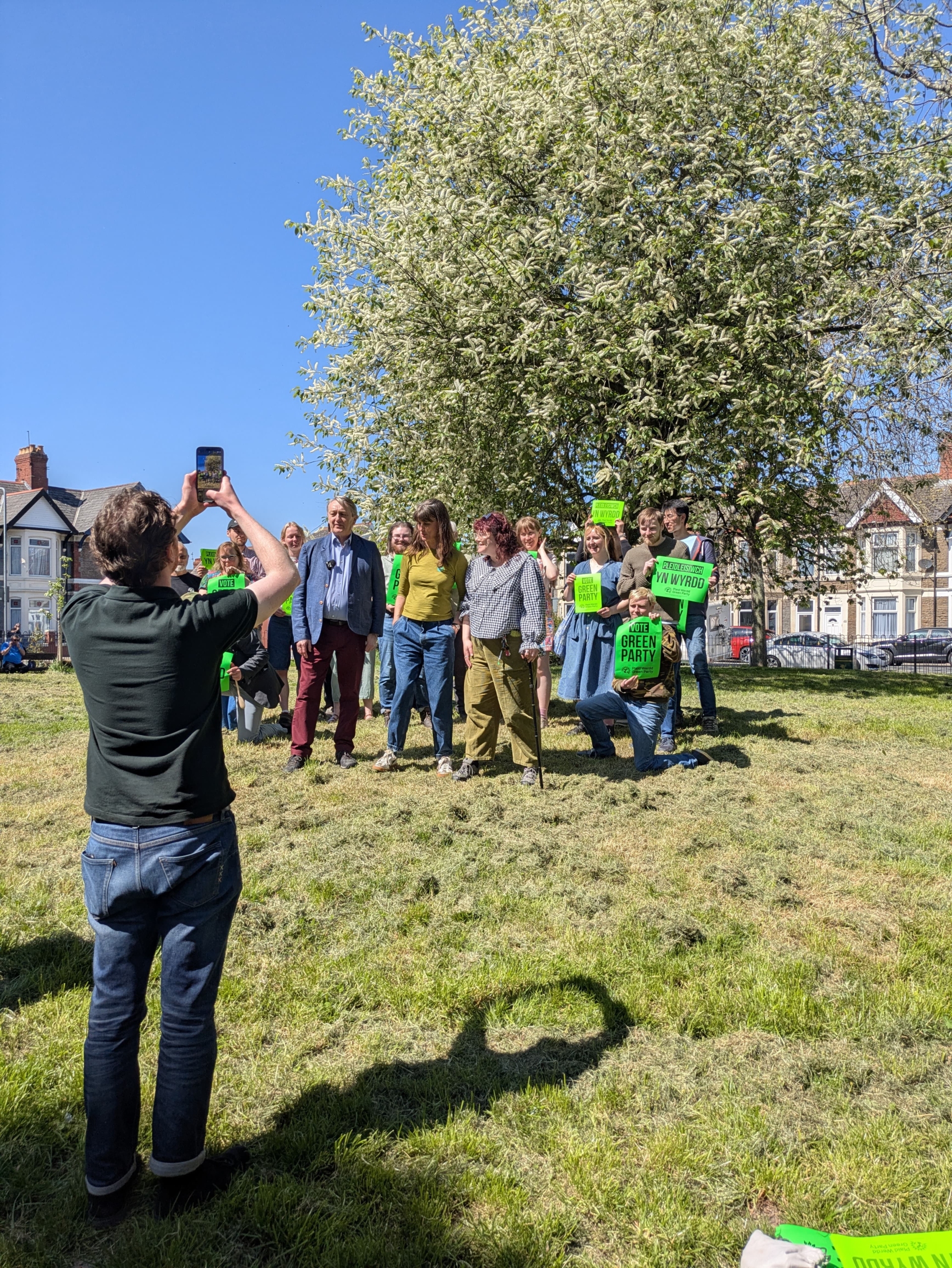
The Greens’ campaign in Caerdydd Penarth, for leader Anthony Slaughter and Tessa Marshall who’s fighting for a second seat in 6th place, is their largest ever in a single constituency. Hundreds of activists. A very janky app. Tens of thousands of leaflets. Campaign selfies and videos.
And yet, the most striking thing among voters wasn’t enthusiasm, it was disillusionment. Door after door, lifelong Labour voters were simply giving up on the party.
Many were drifting toward Plaid Cymru. Some were considering the Greens. Almost all were motivated less by belief than by a desire to block Reform.
Zara, a Canton resident, captured the mood perfectly. A lifelong Labour voter, she now felt the party had drifted from its socialist principles. “Wales has got a bad enough deal as it is,” she said. “I don’t think Reform are really interested in doing anything to uplift Wales.”
She described Reform’s politics as “divisive” and “stomach-churning,” but still hesitated when it came to abandoning Labour entirely. The party’s historical pull as the party of the working class and the default choice to keep the right out still lingers across Wales. Still, she was clearly reconsidering.
“I don’t know,” she said, pausing. “Maybe it’s time for something a bit different.” In Treforest, another former Labour voter was less conflicted. “How do you think it’s been going?” a canvasser asked. “A bit shit,” he replied.
D’hont ask me how it works
Shaping this entire campaign is the new electoral system.
It is called D’Hondt. It involves “super-constituencies.” It is proportional, except when it isn’t. It encourages tactical voting while removing direct accountability. It does away with by-elections entirely and, most importantly, almost no one understands it. In short, it is the kind of system that makes you nostalgic for the comforting simplicity of first-past-the-post.
Wales has been divided into 16 large constituencies, each electing six members via party lists. Voters choose parties, not individuals (unless they go independent), and seats are allocated through a formula that sounds simple until someone tries to explain it and requires laying out dozens of pasta shells to demonstrate it to their mum.
The result is a system that manages to combine the worst features of proportional representation and majoritarian voting.
It benefits larger parties who will get more seats than vote share. Ironically this is likely why Labour chose it over STV (which would likely have helped the Green’s and hindered Reform) because they felt it would benefit them. Yet the party now finds itself having slipped so far in the polls it will likely gain less suits that it’s vote share. Leader Eluned Morgan might even lose her seat!
The system will likely distance representatives from rural voters as parties chose the lists and activists will more likely be centered in places with higher population density. It also introduces a new layer of tactical voting, particularly around the final, sixth seat in each constituency at least for smaller parties.
Plaid claim many races are effectively two-horse contests between them and Reform. The Greens say otherwise. In Caerdydd Penarth, they are pushing hard for that final seat, framing it as a straight fight between their candidate Tessa Marshall and Reform’s Mark Reckless. The implicit message: if you don’t want Reform, vote Green.
However, this framing has been questioned by research from political scientist Jac Larner of Cardiff University, who argues that such claims about “close races” for final seats can be misleading. But elections are not won by people reading academic papers.
The Green Tsunami?
For the Greens, this election represents both a breakthrough and a risk. They are widely expected to win their first-ever Senedd seats. Even two would be historic. Five would allow them to form an official group, unlocking funding, influence, and legitimacy.
Internally, expectations have shifted rapidly. Until recently polls had them winning between 5 and 10 seats, though the most recent Yougov poll had them down to just two. The margins for winning 6th place seats are so small however that even a slight change in support (well within the margin of error) makes a huge difference.
“Realistically, one seat is a foothold,” one candidate told me. “But five is the real foothold.”
The party is racing to increase its campaigning capacity alongside its booming membership.
Under Zack Polanski, the Green Party of England and Wales have seen membership triple. In Wales, that growth has been even sharper, more than quadrupling. Many of the door-knockers I met had never campaigned for any party before. This is their first national election since that expansion, and they are still figuring out how to convert enthusiasm into votes.
Many candidates who signed up expecting to be “paper candidates” now face the very real prospect of legislative office and, with it, scrutiny. Anthony Slaughter even rang round the candidates to ensure they were ready for the challenge.
Angela Karadog in Pontypridd Cynon Merthyr is an example of this. She’s top of the Green’s list in the area where she’s gone from “Planning to campaign hard to build towards next years council elections to suddenly having to plan to potentially step down as a Trustee” of a charity she manages. It has increased her anxiety but she was ready to tackle the challenge.
Paul Rock who was out campaigning with Angela but is also top of the Green’s list in Caerdydd Ffynnon Taf where he may also win was more firm in his determination. “I was always very clear that I felt I could win and that I wanted to win.”
Towards the end of the campaign, the party came under sustained fire over claims of antisemitism linked to its staunch support for Palestinian liberation and opposition to the ongoing genocide. This intensified after Polanski shared a controversial post on Twitter about police conduct following a stabbing incident in London. While Slaughter distanced himself slightly from the comments, party members in Wales appeared largely unphased.
At a campaign event in Canton on the final Saturday before the election, around 150 supporters gathered to hear speeches from Polanski, Slaughter, and Marshall. The mood remained upbeat.
Tessa, proudly wearing a Palestinian keffiyeh, even gave Polanski some locally roasted Hardline’s coffee and Welsh cakes as a show of solidarity.
Despite having shadowed them the weekend before, the party seemed noticeably jumpier about my presence as a journalist. One campaigner told me on arrival, “Zack’s not doing press today.” “Why?” I asked, with a faux-innocent tone.
“It’s not to do with that!” I was told. He was supposedly never planning to do press perhaps due to fatigue from a gruelling campaign schedule. I wasn’t entirely convinced.
Winter is coming and she’s got a van with megaphones
If the Greens are trying to break into the system, Beth Winter is attempting to take it head on.
I met her outside Pontypridd station on a grey Friday afternoon, alongside a campaign team and a van fitted with loudspeakers an approach borrowed from her father, and from a time when politics was conducted by people who were proud of their convictions.
Winter, who was previously a pro-Corbyn Labour MP before effectively being de-listed by the party hierarchy, is now running as an independent also in Pontypridd Cynon Merthyr. Under the new system, this is just about viable. A candidate needs roughly 10–13% to win a seat.
Both her and Angela from the Greens in the area have concerns about splitting the vote between them. Though all sides stressed they wanted to focus on the issues rather than discuss it, it seems clear that both would have preferred the other didn’t run. Yet both sides also have a solid claim, Beth as an established figure in the area and the Greens as an insurgent party.
Winter’s campaign relies heavily on recognition from her time as an MP and her firmly held socialist principles.
One campaigner told me about knocking on a door displaying a Labour poster, only for the resident to immediately switch allegiance upon seeing Winter’ name.
“That’s our Beth,” she said. “Of course I’ll vote for our Beth.”
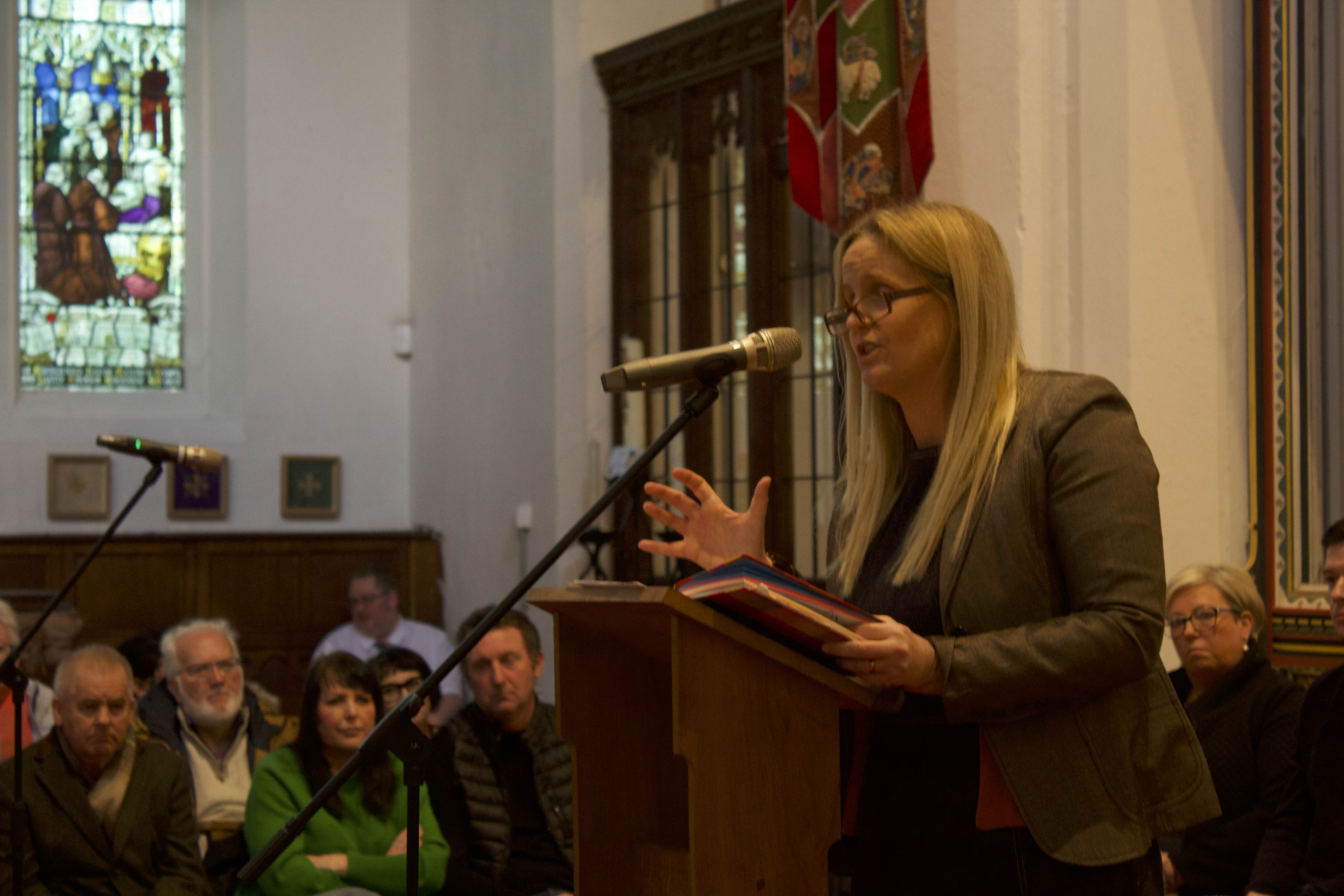
Winter herself is less enthusiastic about the new voting system. She argues it will further disconnect representatives from communities, particularly in large, geographically sprawling constituencies. “It’s taken us a full day just to drive around it,” she said.
Her broader argument is that politics itself has become detached that after years in Westminster, or “in a London bubble” as she put it, she came to see it as fundamentally broken.
She pointed to 27 years of Labour rule in Wales still leaving the country with the highest child poverty rate in Britain, alongside low turnout in her area, as evidence of deep disillusionment.
Her response is a deliberately different model: grassroots organising, community funding, and a commitment to give away more than half of her salary if elected. “I want to share it and reinvest it in things like local campaigns… we’ve got pockets of brilliant initiatives across our valleys… we’ve got so much to be proud of,” she said.
It is both an ideological stance and a practical one, an attempt to make politics tangible again.
“We’ve still got a sense of community. We’re still a proud population and that is the alternative that people need and deserve.”
She sees this as a counter to Reform and “the terrifying prospect of the far right being embedded in our communities.”
Coalition or Reform
Which brings us to the Reform bogeyman of the election. Polling strongly. Largely isolated. Unlikely to govern as no party but the Tories will work with them.
Several people suggested this might be the ideal outcome for them: strong enough to claim momentum, excluded enough to claim victimhood. In a scenario where Reform wins the most votes or even the most seats but is blocked from power by a Plaid-led coalition, the narrative writes itself.
The stolen mandate by the establishment. A stitch-up by the Cardiff bay elites. It is, from a certain perspective, politically effective. I did attempt to speak to Reform campaigners to understand their strategy first hand.
My offer to shadow them was declined. Or, more accurately, ignored.
Political earthquake or more of the same?
By the time polls open tomorrow, Wales finds itself in the middle of something that feels both historic and oddly anticlimactic.
Labour’s once uncontestable grip on Wales is collapsing, putting the lie to Peter Mandelson’s famous claim that the working class “has nowhere else to go.” Yet on the ground, most people don’t seem enthused, just opposed to Reform.
A new voting system promises fairness while confusing almost everyone involved. Parties talk about momentum, mandates, and sixth seats, while voters simply fear the worst or just want enough money to get by. By the end of it, we may have a new government, a reshaped political map, and a handful of very surprised Senedd members who didn’t expect to be there at all.
Whether any of it resolves the deeper sense heard on doorsteps and shouted at politicians in car parks that things simply aren’t working is another question entirely.