
there’s billions for war planes but nothing to fight raging wildfires
As fires spread across Cymru, thousands of people are asking why there has been no aerial support to tackle them. At the same time, the UK Government has boasted spending record amounts of money on war planes – not to fight forest fires but to drop bombs.
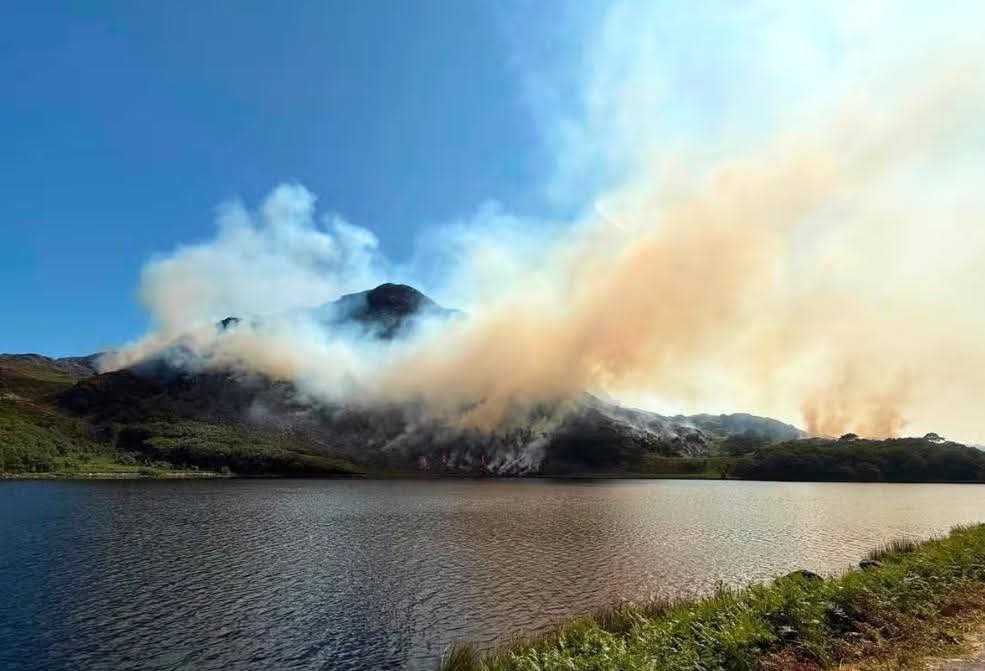
By Adam Johannes, anti war activist and climate change campaigner*. Cover image: the Rhinogydd range fire, via Cym Bychan Farm
A petition calling for helicopters or water-bombing aircraft to be deployed to tackle the Rhinogydd wildfire in north-west Wales has attracted thousands of signatures.
Meanwhile, people across Cardiff, where I live, are once again asking what is that smell of burning in the air? The answer is another wildfire in Blaenavon, more than twenty miles away, which has been raging since Sunday.
But these are not isolated fires. Wales is burning. Alongside the critical incidents in the Rhinogydd and Blaenavon, wildfires are raging on Conwy Mountain and on grassland overlooking the A55 in Flintshire. On Thursday morning, another fire was reported near Presteigne, covering an area of around 90 hectares, roughly the size of 120 football pitches.
Sian Williams, operations manager for Natural Resources Wales, described the situation across Wales as “exceptional.”
“Unfortunately, despite us putting a request in, at the request of the fire and rescue service… for aerial support, we have not been able to secure that yet,” she said. The fires are here. The terrain is difficult. The ecological, economic and human consequences are serious.
The petition calling for aerial support makes the case abundantly clear:
“Aerial firefighting resources, such as water-bombing aircraft and helicopters, are proven to be highly effective in managing and extinguishing wildfires swiftly. These resources can access remote and rugged terrains, dropping water and fire retardant directly on the fire’s critical areas, something that ground forces might struggle with in vast and challenging landscapes like Rhinogydd…The ecological and human costs of this wildfire are profoundly concerning, and action must be taken immediately.”
But the Welsh Government has said that no airborne firefighting capability is currently available for deployment anywhere in the UK.
Read that again.
One helicopter has reportedly been secured by NRW but this wasn’t due to arrive until Friday, days after the fire started spreading.
The UK Government has just announced a Defence Investment Plan committing £298 billion to the military over the next four years. It is adding another £15 billion to previous commitments, taking annual military spending to almost £80 billion by 2029, more than at any point in the last thirty years.
And still we are told that we need to spend more. Andy Burnham appears determined to oblige. After appointing the war hawk John Healey as Chancellor, arms companies saw their share prices rise.
The Labour Government in Westminster can find billions for fighter jets, warships and weapons systems designed to project military power across the world. But when our own communities face increasingly severe wildfires, floods and the consequences of climate breakdown, we are told there are no helicopters or aircraft available to help them.
What does it mean to defend a country if you cannot protect people from the emergencies already threatening them? There is apparently large sums of money available for new fighter jets that can carry nuclear bombs. But when people need aircraft to fight a wildfire in their own country, suddenly there is no money.
This is not a question of whether we can afford to protect people. We can. The welfare state, climate resilience and properly funded public services are not luxuries. They are what keeps people safe.
So, if our governments can spend billions preparing to fight hypothetical wars while failing to equip communities to deal with the very real consequences of climate breakdown, then we need to ask a very basic question: Who, exactly, are these governments defending?
*Adam Johannes is joint secretary of Cardiff Stop the War Coalition, and in 2006 helped organise the first major protest in Wales demanding action on climate change.
You can sign and share the petition here:

What Obama’s Failure In Copenhagen Says About COP26 & The Climate Movement Today | Jonathan Neale