
“We’re here to organise working-class people no matter who they vote for” – The union fighting for tenants in Wales
From no-fault evictions to the use of barbaric bailiffs, landlords and letting agencies are making life unaffordable for renters and deepening the housing crisis in Wales. O Kour speaks to tenants union ACORN Cardiff about why residents in Wales deserve at least the same protections as those in England, and why the system must radically change.
*Names have been changed for privacy. By O Kour. Cover image, members of ACORN Cardiff outside Welsh Government.
Rafiq* and Almara* arrived in Cardiff with their two young children, from Ethiopia as refugees, not long ago. Even though they could briefly converse in English, they chose to enrol their children in Welsh-language schools, hoping to build a life in a country that is regarded as the ‘Nation of Sanctuary’ — a place they could someday hope to call home.
While living in temporary accommodation, the family received an offer of social housing from Cardiff Council. However, they declined the property as their children would’ve had to switch schools.
However, they were unaware that under the government’s homelessness code of guidance, if you turn down an offer deemed suitable by the council, they can refuse to rehouse you. And due to a lack of proper communication with the council, they soon received an eviction notice. Feeling helpless, the family turned to ACORN for help.
Nora, Chair of ACORN Cardiff, says, “They weren’t aware that if you refuse an offer of social housing while you’re in temporary accommodation, the council decides that you are intentionally homeless, and evicts you.”
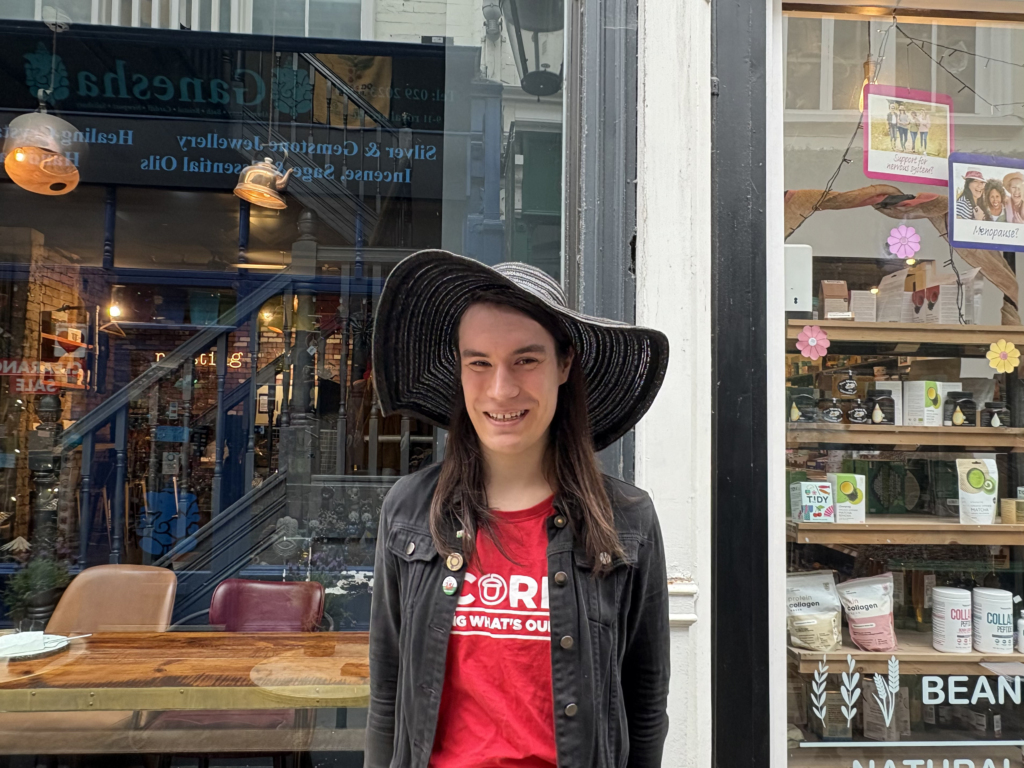
ACORN exhausted all official channels to halt the eviction, but to no avail. “We begged and pleaded with the council,” says Nora. “A councillor said, ‘Don’t worry, once they’ve been evicted, they’ll be homeless, which means that the council has a duty of care and they’ll be put back into temporary accommodation soon.’
“That’s a cycle of getting temporary accommodation, getting offered a house that’s not suitable, evicted, homeless, back in temporary accommodation,” said Nora, who is homeless herself. “This needs to stop. It is unacceptable that members of my community are being treated this way.”
Ultimately, around 30 ACORN Cardiff members stood in front of the family’s accommodation and physically blocked the eviction until the bailiffs scattered away. The family has since settled into a permanent accommodation.
In an Instagram post, ACORN Cardiff shared the family’s response: “When Cardiff Council was preparing to evict us from our temporary accommodation, we were scared, uncertain, and felt like we had nowhere to turn. But then we found ACORN.
“From the moment we reached out, ACORN members stood by our side… Because of your dedication and tireless advocacy, the eviction was stopped, and now – thanks to you – we have a place we can finally call home. This new chapter for our family would not have been possible without your support.”
“That’s a cycle of getting temporary accommodation, getting offered a house that’s not suitable, evicted, homeless, back in temporary accommodation.”
Inside Wales’ housing crisis
Over the past five years, Wales’ housing crisis has only worsened. Average monthly rents have surged by 50%, rising from £550 in March 2021 to £828 in March 2026. In Cardiff, rent hikes are outpacing even London by a third. Flatsharers are having to fork out £2,000 more per year to cover their bills. Last summer, there were almost four times as many prospective tenants as rooms available.
This crisis disproportionately affects working-class and low-income households. With wages stagnating amid a cost-of-living crisis, people are being forced to spend unsustainable portions of their income on housing, ultimately pushing tenants into precarious living conditions, right into the hands of unruly landlords with minimal accountability and zero safeguarding systems in place.
In Grangetown, Cardiff, residents of a 13-storey tower in the Channel View estate have been left to live in decaying conditions. The building is infested with damp, black mould, leaks, flooding and sewage problems. Many residents, most of whom are elderly, were informed a decade ago that the block would be demolished and replaced with new flats. This was in 2016 — and work is yet to be completed, leaving residents exposed to serious health and safety hazards.
Describing the building’s condition, Nora says, “If you go inside, there are holes in the wall where the bolts for the cladding used to be. The electrical box is in a room filled with black mould and damp. ACORN have done quite a few door-knocking sessions at Channel View… So there’s no cladding, it’s freezing in winter, it gets really wet, everyone there seems to have problems with respiratory issues, breathing, and Cardiff Council was like, ‘Don’t worry, we’re going to rehouse you.’ But nobody seems to know when that project is going to finish. They keep delaying it.”
Rogue landlords
Cases like Channel View don’t exist in isolation. Across the country, households face a broader pattern of neglect and exploitation at the hands of various stakeholders. Arguably, the biggest benefactors of all are the landlords, or their middlemen, letting agencies.
Pushing rent hikes on tenants, while the most direct method, is not the only thing used by them to continue lining their pockets. Nora says, “Their MO is stealing deposits from people who don’t know how to challenge, who’ve not got the time or energy to go through the lengthy complaints process, forgotten to take pictures or evidence when they enter the flat and when they leave.”
With the criteria for the ‘perfect tenant’ becoming increasingly strict, landlords are now demanding larger deposits, rent paid months in advance, rigorous employment checks and higher affordability thresholds. As a result, many prospective renters are finding themselves excluded and pushed out of the rental market before they even begin looking for a suitable place to live.
Their MO is stealing deposits from people who don’t know how to challenge, who’ve not got the time or energy to go through the lengthy complaints process.
“[Asking for] rent in advance and guarantors heavily impacts queer people, because if you’re estranged from your parents, who do you ask to be your guarantor? Who puts up the rent in advance? That’s a real barrier to lots of different people, also to international students, to refugees, people who’ve lost their parents or who are in various conditions, or their parents just don’t have a home and can’t act as guarantors. It undermines people’s dignity as free adults.”
Nora explains how some letting agencies create additional revenue streams through in-house cleaning services. “We’ve found that letting agents also happen to own a cleaning company. The cleaning company claim the whole deposit for cleaning costs, and then [agencies] can say, ‘Well, the cleaning company charged this for cleaning the flat.’ So, the power letting agents and landlords have is that they have money, connections, they own law firms, cleaning companies, they have working relationships with bailiff companies, councillors. They own all these apparatuses.”
Can’t pay? Bailiffs will take it away
While some councils, like Hammersmith and Fulham, have stopped the use of bailiffs for debt collection, the practice still largely remains in use, increasing by 30% in England and Wales in just two years. Between 2024 and 2025, Cardiff Council made 8,719 bailiff referrals for council tax debt, up 14.4% from the previous year. In Pembrokeshire, the use of bailiffs rose by 69% to 1,260, while that figure increased to 2,823 in Swansea, a rise of 75%.
A large proportion of those pushed into council tax arrears are already struggling with other forms of debt due to austerity measures and the subsequent cost of living crisis. Data shows that 72% of people in council tax debt were already in energy debt.
Nora says, “A lot of people who are in really deep poverty, who can’t pay all their bills, they’ll prioritise particular bills, right? If you have young children, you need to pay for food, heating, water. What’s the thing that you don’t need to pay for? Council tax. But obviously, that sends you into council tax debt. And then bailiffs come round of your house, intimidating you.”
Citizens Advice reveals that one in three bailiff visits deploy illegal tactics, while 64% of people face harassment. In fact, bailiffs themselves have told ACORN members about the barbaric methods they use. “The first thing they threaten to take from a house is children’s toys,” says Nora. While bailiffs legally cannot take away essentials or kids’ toys, it doesn’t stop them from making baseless threats to unknowing people. “They don’t have much value for resale, but they’re very strong leverage for getting that person to pay the debt, no matter what it costs them.
“The other thing they [threaten to] take is the ashes of deceased relatives. They’ll look on the mantelpiece to see if there are any urns, on the basis that people will pay anything to get that sentimental, deeply personal object [back].”
According to Step Change, around 53% people who have experienced bailiff action said the enforcement agents pressurised them to repay debt they couldn’t afford, while a third deployed intimidation or aggressive tactics. This negatively impacted over 90% of individuals’ mental and physical health, including their ability to sleep or feel safe in their own homes.
The other thing they [threaten to] take is the ashes of deceased relatives.
Naz, a member of ACORN Cardiff, describes these tactics by landlords, agents and housing moguls as “psychological warfare”. “Capitalism feeds off of this apathy that it creates in people, and it will use any form of dirty tactic, like going for your children’s toys, which have absolutely no monetary value, but it’s the sentimental value that they have.”
Nora adds, “With evictions and debt collection, councils, letting agents and landlords are hiring a private army of thugs to wage class war on our communities. That is social cleansing. They are waging a class war on us. We have to fight back. We have to defend ourselves… because we don’t have any other choice.”
The case for rent controls
Two years ago, ACORN members occupied 30 TSB branches across England and Wales, targeting a little-known clause in the bank’s buy-to-let mortgages policy that restricted landlords from offering only 12-month tenancies. In practice, this locked renters into short-term contracts, after which they were forced into either a rolling contract, another one-year contract, or to leave as their last resort, with little real choice over how long they could stay. Following ACORN’s mobilisation, TSB was forced to amend the clause to allow tenancies of up to three years.
“We want the rent controls to be directly by politicians. We want decision makers who can be held accountable. We’re really sick of being ignored.”
While that victory shows what collective action can achieve, it also exposes the structural inequality in agency and power between landlords and renters. Short-term contracts make it easier for landlords to raise rents — even renters with longer tenancies risk sharp increases towards the end of their contracts.
This is why rent controls are necessary, says Nora, but there’s a lack of accountability and transparency around who enforces these legislations. “There’s a real problem in this country with regulatory capture, with institutions that are meant to police businesses, coming under the sway of said businesses. We want the rent controls to be directly by politicians. We want decision makers who can be held accountable. We’re really sick of being ignored.”
Scotland is taking active measures to implement rent controls, while London’s mayor, Sadiq Khan and Greater Manchester mayor Andy Burnham have both called for Westminster to impose rental caps. Last month, chancellor Rachel Reeves was rumoured to be considering a one-year rent freeze in England due to the aftermath of the US-Israeli war on Iran, but it has since been ruled out by Labour.
It’s the “Wild West” in Wales when it comes to housing, says Nora. “There is a fundamental power imbalance in the Welsh housing system. Whatever the landlord says goes. What the law says doesn’t really matter when this person [landlord] has access to all these services, like bailiffs that can turf you out. Wales doesn’t need letting agents or landlords, it needs houses.”
In comparison, the English housing reforms — or the Renters Rights Act — might seem like a bed of roses, but it’s nowhere near enough. What it does indicate is a way forward towards stronger tenant protections, more affordable housing and rent controls.
“Ending Section 21 was one of our key demands”, says Nora. The act, which has now been abolished in England, enabled private landlords to carry out no-fault evictions against tenants with assured shorthold tenancies (fixed-term or rolling contracts, which are most renting agreements). “Wales is behind on that, but even in England, you can still do a backdoor or no-fault eviction, because you can increase the rent by any number you can think of. Then, [tenants] can’t afford it, so they have to move out.”
We’re here to organise working-class people no matter who they vote for.

Some of these rental reforms could make their way into Wales. The Senedd elections on 7 May saw Plaid Cymru overthrow a century of Labour dominance, falling just six seats short of a majority.
In its first 100 days in office, Plaid Cymru has pledged to establish a national development body to oversee social housing. The party has also promised legislation introducing a Right to Adequate Housing, measures to tackle fuel poverty, speed up work on unsafe or hazardous properties, and hold developers to account if they fail to meet deadlines. Plaid has also pledged to ban no-fault evictions and rental bidding wars.
As Plaid Cymru will be operating as a minority government, it will need majority support in the Senedd to pass legislation and budgets, making cross-party cooperation essential.
Arguably, its strongest external backing will come from the Wales Green Party, which entered the Senedd for the first time with leader Anthony Slaughter — who is also an ACORN member — alongside Paul Rock. The Greens were also the only other party besides Plaid to support Ap Iorwerth’s bid to become First Minister. At the same time, they are expected to keep pressure on Plaid over key manifesto pledges, including replacing council tax with a land value tax, freezing rents before introducing rent controls, and investing in early homelessness prevention.
Regardless of the Senedd’s political makeup, ACORN says its focus remains on securing safe housing for all. “We’re here to organise working-class people no matter who they vote for,” says Nora. “When it comes to the systemic issues in Cardiff, we have all these working-class groups who are treated like scum. A lot of people that we’ve spoken to, their actual problems in life are: the council’s treating them like shit, their landlord’s treating them like shit, their boss is treating them like shit. Then you’re like, ‘Okay, so what do you think is causing this?’ They’ll be like, ‘It’s the migrants.’
“The key thing here is realising that actually, your anger is completely justified, but you’re pointing it at the wrong people. Racism and other forms of bigotry is not helping anyone. What we want is for people to talk through their problems and realise this themselves.
“We’re all part of the same class. This is the community I live in. This is my city and their city. And we’re meant to be sharing it.”